Fred and Edna used to have to walk to Lae which was an eight hour walk

Scherle, Reverend Fred and Edna evangelism and social concerns. 1946 to 1967. 1972 to 1981. They were stationed at Malalo from 1946 to 1961. Fred recruited Alvin Erickson to the missions and Alvin replaced Fred at Malalo in 1962 and theScherle’s moved to Mumeng. The Scherle’s organized the rebuilding the station at Malalo after WW II before Ina and Alvin Erickson took over. Originally, he had been asked to play professional football by Chicago Bears. But he chose to become a missionary instead. He was a big guy and he lost at least 100 lbs. while he was in PNG. He had suffered from dysentery. He had come on furlough while Alvin Erickson and classmates were seniors at Luther Seminary. He had the talent of a salesman and convinced 4 of the seniors to go to PNG. He recruited Alvin Erickson, Dave Huff, Ted Hilpert and Bob Jamieson. Alvin was the only one that ended up with Fred Scherle in the Jabem district.
The following is a summary of the letters for March 1963 — Holding Fast in a Dry Season - their are alot of letters for this month so spreading across next 2 blog posts
March arrived at Malalo carrying both relief and strain.
After months of drought, the first rains finally came—not enough to restore the gardens fully, but enough to soften the ground and lift spirits. The mornings were cooler now, cool enough that people felt able to work again. Planting began cautiously. Everyone knew better than to trust the weather too quickly.
From the hill, the land looked unchanged—sea below, mountains rising behind—but life beneath that view was under pressure. Food remained scarce. Gardens had failed. Schoolboys and girls walked long distances each week back to their villages to search for more food. Those who lived too far away worked for the mission and were paid in brown rice. Closing the school had been discussed seriously, but the students and villagers worked things out themselves. It was not easy, but it held.
Words from the Mountains
Letters moved constantly between stations, carrying encouragement, requests, humor, and shared fatigue.
From Kaiapit came news of another corner of the work: heat that lingered into evening, a dry “wet” season that refused to behave, and the peculiar comforts of pets, music, and shared meals. Korrine Oakland wrote with warmth and wit—about kittens, parrots that swooped into hair, chicks that followed people like shadows, and the comfort of playing the autoharp for Mrs. Pietz, whose tears spoke of how much music was missed in isolated places.
Her letter reminded Ina how interconnected the stations were. What happened at Kaiapit or Bula was never far removed from Malalo. Teachers moved. Needs overlapped. Everyone lived with the same limits.
She asked Al for a favor: to have a cross carved by the craftsman at Buakup—a large one, two feet tall, meant for her congregation back home. The request carried urgency. Time was measured in months, not years.
The carver, Hoboic of Buakup, was already known for his skill. His crucifix would eventually stand on the altar at Malalo—a local hand shaping something sacred, meant for worship far beyond the coast.
Rain, Rust, and Improvisation
When the rains did return, they brought their own problems.
Louvers rusted open and could no longer be cleaned. One night, heavy wind and rain knocked out the electricity. Kerosene lamps failed in the gusts, rain driving in through open windows. A blanket was hung to block the wind, but it did little good.
That evening, a coffee party for local friends went on anyway—by flashlight placed in the center of the room, laughter and conversation continuing as if nothing were amiss. Improvisation had become second nature.
Repairs would have to wait. Aluminum louvers would need to be installed. Pipes had already been damaged—perhaps by one of the many small earthquakes. Water tanks leaked. Kitchen drains failed. Ina joked about needing a plumber, naming her Uncle Claude half in hope.
Life and Danger Close at Hand
March brought reminders of how narrow the margins were.
Ina watched the captain’s wife closely as her pregnancy advanced—unusual swelling, worrying signs. She sent her to Lae for testing, only to have her sent back with no explanation. Ina trusted her instincts instead, monitoring her daily.
When labor came at 4:30 in the morning, there was no hesitation. Supplies were gathered quickly—ampules, gloves, iodine, newspaper spread on the floor, kerosene lamp lit. A native nurse was summoned. Ina prepared, left briefly to care for her own family, then hurried back down the hill just in time. A healthy baby girl was born. Ina delivered the placenta herself.
The relief was quiet, professional, and immense.
Danger appeared elsewhere, too. A ladder leaned carelessly against the veranda railing. Tommy climbed it, somehow reaching the top rail eight feet above the ground. Schoolgirls shouted warnings. Ina ran out to find her son lying calmly on the railing, perfectly balanced. How he reached that last eighteen inches without falling, she never knew.
She took him down firmly. He protested loudly.
She was convinced he had a guardian angel.
Family Life, Observed Closely
The children grew, talked, played, and tested boundaries constantly.
Paula (2 almost 3) talked endlessly—reciting who woke up when each morning, lining up dolls and blankets, making sure everyone was accounted for. She spoke of grandparents often, imagining visits and “nice big houses” she had never seen.
Tom ( 18 mo) delighted in hiding his spoon, pretending it was lost, then producing it triumphantly. He begged for food for “Pawa” as well as himself. He pored over magazines, pointing out trucks and cars, demanding names for everything. Rollerskates fascinated him. He walked across the floor in them, unable yet to skate but entirely pleased with himself.
The children had no other white children to play with. They had each other—and a world of adults who watched them closely.
March also carried quieter family news. Ina was expecting another child in the fall. She wrote of it matter-of-factly, woven in among pipes and children and budgets, yet with clear joy. Life was expanding even as resources were stretched.

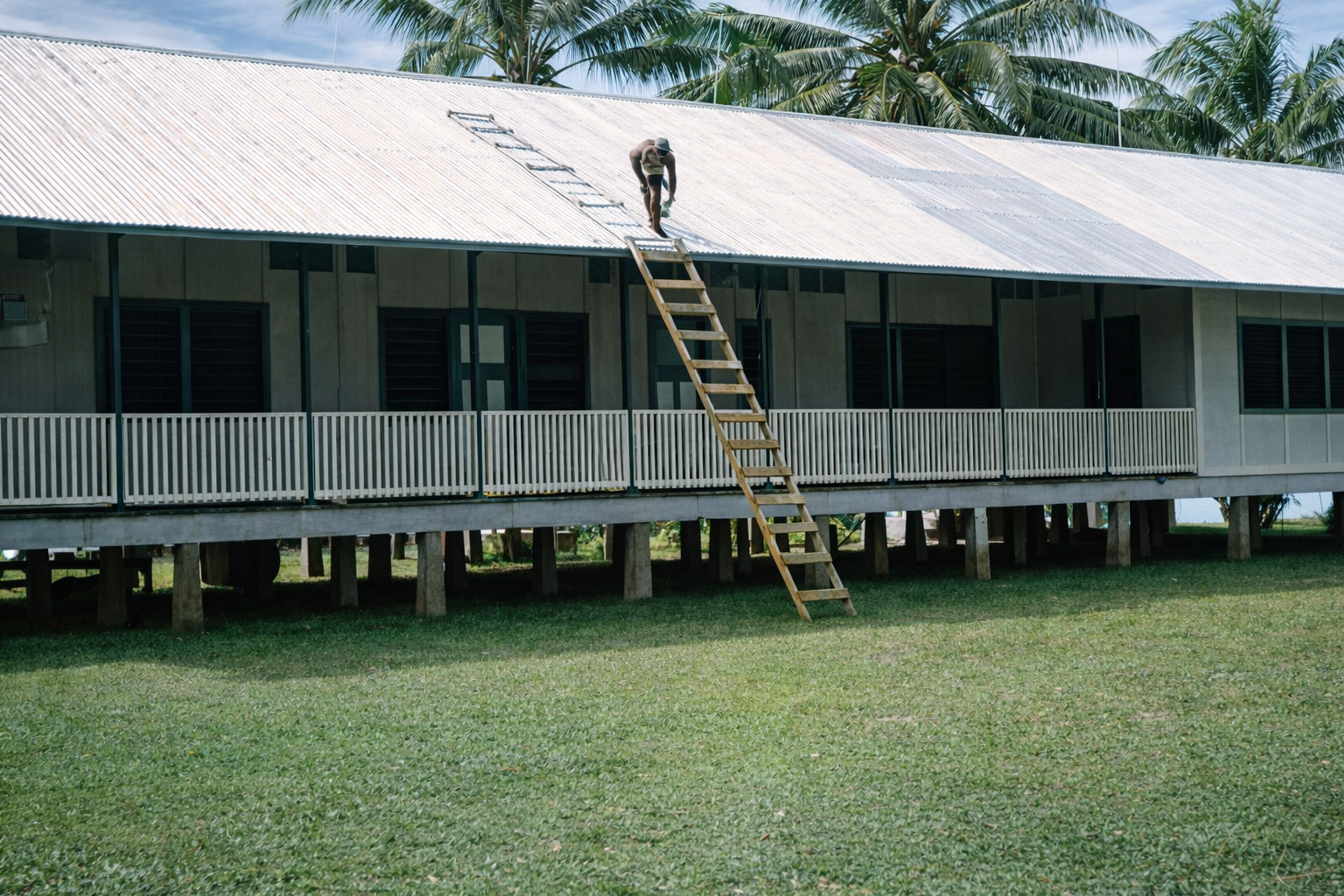
Toys left on veranda for all the children on the Station to play with. The railing on the veranda Ina mentions Tom climbing on.
Paying the Cost of Independence
Much of March’s work centered on difficult transitions.
The Malalo church was being guided toward independence. This meant decisions that were not popular. Medical care, once entirely free, now required a small payment—two pennies per visit. The money would go toward food for the nurses and aides who staffed the dispensary.
Some worried people would stop coming.
They did not.
Instead, they adjusted. Slowly. Uneasily. But they came.
The dispensary itself was being rebuilt—cement floors, framed walls, screened windows, cupboards with doors to keep out flies, cockroaches, and white ants. Clinics were organized: one for expectant mothers, one for babies. Nurses would begin visiting villages weekly to care for those too sick to walk.
This was progress measured not in speed, but in sustainability.
On the Water Again
Travel never stopped.
Al wrote from the Victor as it headed toward the sawmill. Plans were underway for a wharf—an iron box sunk into the sea, a pole rising from it. It was not ideal, but it was possible. Everything here was a compromise between cost, distance, and ingenuity.
The drought continued to press. A bull was slaughtered to feed students. Outside help was requested—German aid to help feed schoolboys during the worst of the shortage. Tools sent from home were used constantly and with gratitude.
Through it all, letters went back and forth—news, humor, prayer requests, glimpses of ordinary life held up against extraordinary demands.
Holding the Work Together
By the end of March, nothing had resolved neatly.
The rain was not enough. The work was not lighter. Independence remained unfinished. But the systems were holding. The people were learning. Children were growing. Babies were being born. Worship continued—in churches, in villages, on mountain paths.
From Malalo, between sea and mountains, March passed as so many months did: not triumphant, not defeated, but sustained—by attention, effort, and the steady conviction that this life, demanding as it was, was worth holding together.
The following are the actual letters for March 1963
1963 March 15
Letter written by Ina Erickson from the Malalo Mission station to Durward and Estelle Titus Box 224 Route1, Carlos MN USA
Dear mom and dad, Willa and Martin, Mickey Lain, Jennifer,
It is getting dangerously close to someone’s anniversary1, and I don’t think we’ve sent our best wishes, and congratulations. What is it 28 years? That is a long time to put up with each other.
Thank you so much for all your work on the program at First English. We surely do appreciate any promotion of the spreading of the gospel. It is very heartening to have our home people so interesting what is happening in this part of the world.
It surely is a different world. The people at home have provided the mission with enough money so that we can live comfortably. At first the missionaries lived in the bush houses like the natives, and cook their food over open fires like the natives do, but the toll and mental and physical health was so great that better living conditions had to be provided. Refrigerators were a luxury at first, but it has proved to save both cost of food and in health so they are now standard equipment.
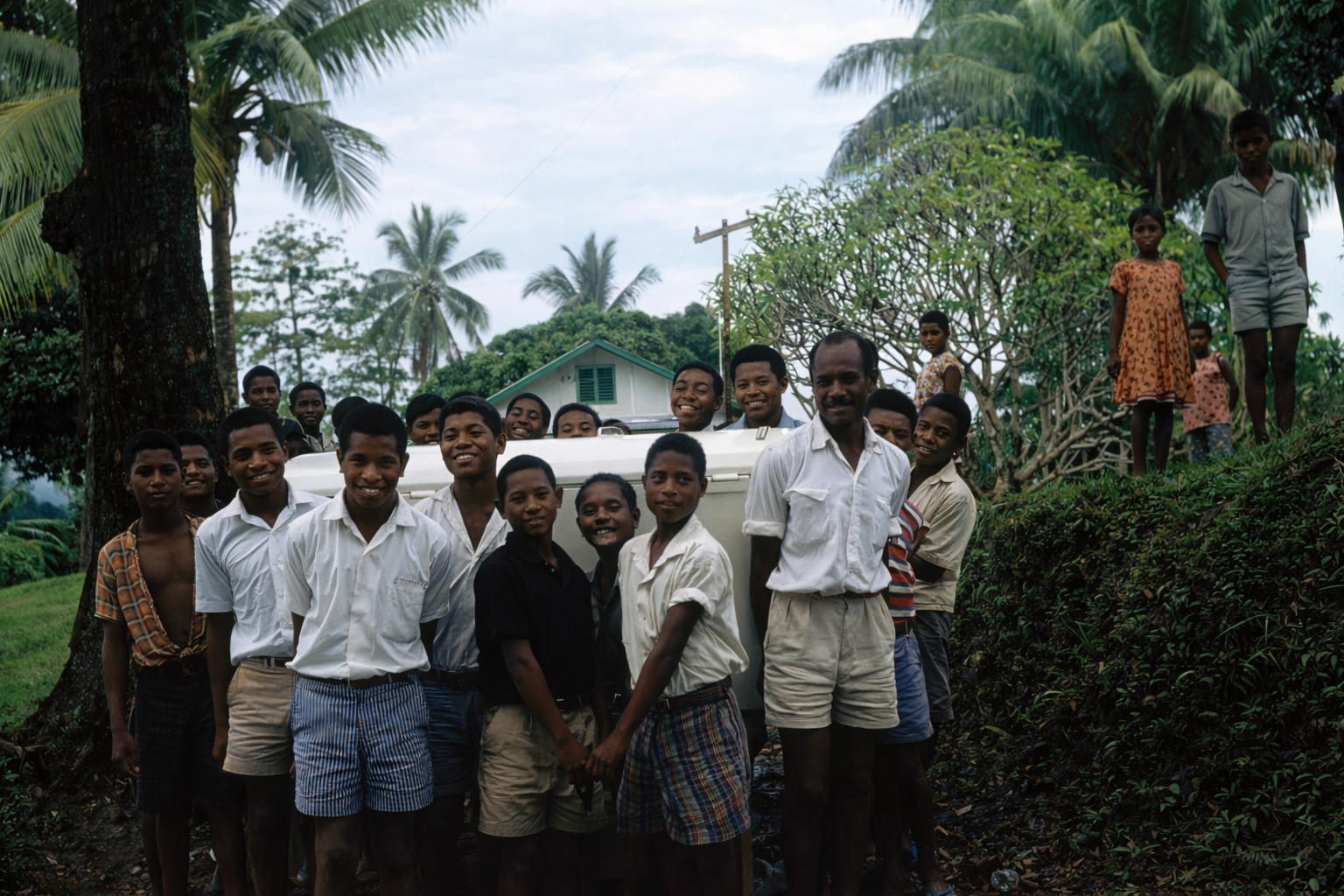
Can you imagine carrying up a refrigerator up the Malalo Hill?
Electricity has enabled us to work at night and what is more important to have school at night. The boys and girls can study their lessons in a screened lighted school room instead of hunched over their small kerosene lanterns if they are rich enough to own them, or their fires if they are not. The bugs bother them so much that they wrap in their blankets. Or most of the mission work was done on foot and one had to walk days in miles to get supplies, now most missionaries are supplied with vehicles of some sort or another.
Fred and Edna used to have to walk to Lae which was an eight hour walk and get what food they could carry back to get their mail once in 2 or 3 months. Now we have the Victor and can go in every week. We have people that take their vegetables like taro, long tough green beans, pumpkins, bananas, pineapple, coconut, pit pit (that grows something like corn in a long slender husk but doesn’t have kernels like corn and taste like cauliflower), fish, sometimes eggs, and occasionally a pig. They can take their goods free but must pay nine shillings for a round-trip ticket- roughly 1 dollar. They sell them in a native market. Someday I will have to send you pictures of it.
This letter continues with the packing for a bushtrip which I posted so not including it here.

Malalo yard facing west or away from the ocean view. The only flat area around so lots of activity happened here such as playing, feasts, celebrations, the Christmas pagent etc. You can see the footpath that leads from coming up the Malalo hill past the church and dispensary on the left and leads towards the staff housing and trails to the mountains “behind” Malalo as Ina describes in her letters.
Al’s main task now is to make the New Guinean church of Malalo independent of the missionary.
1963 March 15
To Gertrude and Lawrence Rasmussen, 112 Jefferson, Stevens Point, Wisconsin, USA 1
Dear Gertrude,
Surprise, nothing really has happened to us, except that I can’t get my husband to sit down long enough to write letters. I’ve been writing the last few form letters and he wanted to write the next one. This was well and good as I am most certainly not the literary member of our family.
Last November, I started to remind him that it was time to get a letter out for Christmas, yes he agreed it was, but well, he just never got to it. It seems every time he goes to the office he has a bunch of men waiting to talk to him over one problem or another. I have been suggesting and threatening and what not and still don’t have any results. I even addressed an air letter to you and left it on his desk. But I still didn’t have any results. Now he is off again to the Buang mountains for another trip. I decided that I would write another letter just to let everyone know that we are still alive and that we are still interested in our fine friends at home. We just won’t mention the fact to the Bingsu, and maybe just maybe he might still get a Easter greeting out.
We have had our ups and downs with malaria and hot weather, but as a whole we’ve been quite well. Over the school holiday of December through February 1 we had so much company, but hardly a day went by that someone wasn’t here. Malalo is a popular vacation spot as we have a lovely swimming area free from sharks, and many beautiful views from our lofty mountain home. It was so lovely to have everyone come as we would never see them otherwise. We go for weeks without seeing any white faces. As we get to know and understand our brown neighbors this doesn’t bother us much anymore. But it is wonderful to be able to sit down and talk fluently with someone, however. I guess that is one of the things that we missed the most.
Thank you for being so good about sending out our letters. Many people have commented that they do appreciate them, so I thought I would tell you.
You are pretty brave to learn to drive, and then to have the nerve to drive in winter weather. We’d like to have a picture of your new house if you have one to spare and also would enjoy a picture of the Rasmussen’s also if you have one.
It has been so hot and dry this season as a matter fact, this has been the dryest season that many people can remember. Our people have had a hard time getting enough food, as their garden didn’t produce. After three months of very little rain it has started to rain more again, but we still could use a great deal more.
Our fruit trees have continued to produce so we could supplement the diet of our school boys and girls with a little fruit. They have had to walk back to their villages every week to get more food, as the gardens here are completely ruined. Those that live too far have been working for us some and then we pay them in brown rice. We are afraid we’d have to close the school until the drought had ended. So many of the boys and girls were hungry. We’ve tried to help them but feel this is one of the problems they were going to face if they are going to be a self-sufficient nation, so we didn’t give them any food, which of course would’ve been the simplest thing to do. They have worked things out for themselves pretty well and we didn’t have to close the school.
Al’s main task now is to make the New Guinean church of Malalo independent of the missionary. His job is to work himself out of a job. It’s like we’re dealing with growing children. They often want the privileges without the responsibilities, but with God‘s guidance and patience maybe someday this will be a reality.
One thing we are working on now is to learn to pay for their medical attention. Now the government and mission furnishes all the medicine and hospitalization. What we are going to try to do is to collect two pennies from each person that come for treatment. With the money we will buy food for the native workers in the dispensary. They now get a salary about $20 a year paid for by the Malalo congregation. Our doctor boy left as he could get more money from the government. We will have two nurses returning, from their nurses training, so we want a little more for them so they will stay. Whether the people will continue to come if they have to pay their two pennies a visit, I don’t know but we do think it is a necessary step forward.
As these people have to learn to pay their way as they can, they will resent us more and more. We know we will be unpopular, but definitely feel it is the wrong thing to keep the people depended any longer. Please pray for wisdom and courage in these new steps.
God’s blessings to you and yours.
Love in Christ
Al, Ina, Paula and Tom

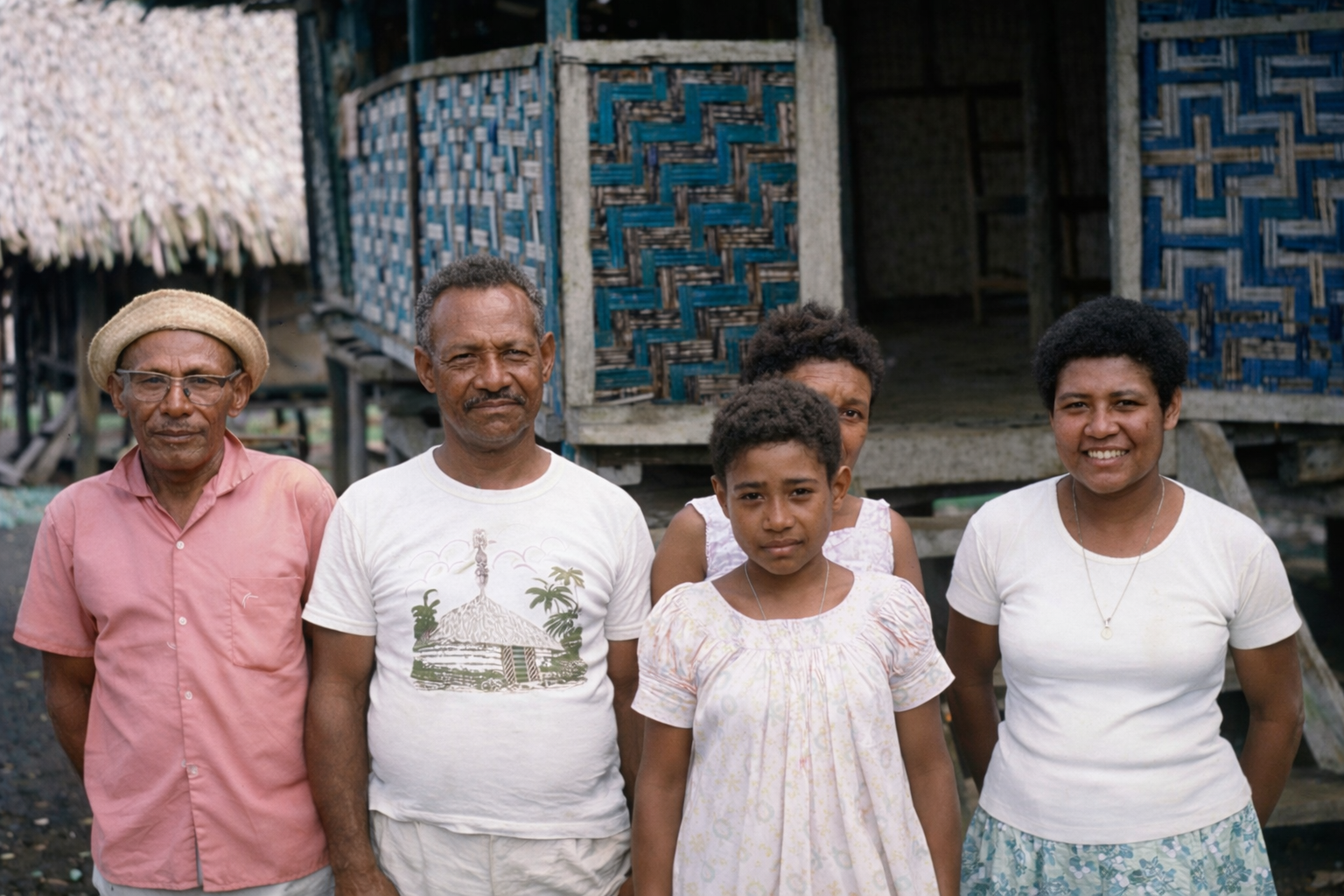
School children with Tom in the middle and I believe some of Gideons children to the right of Tom. Based on Tom’s size perhaps taken late 1963 (when everyone is eating again)
Footnote:
1 Rasmussen, Gertrude, and Lawrence from Stevens Point, Wisconsin, USA. Erickson’s met them in Stevens Point during Alvin internship. They had 2 sons. One son John, went to St Olaf who was killed in a car accident. They were strong Christian people. They had agreed to spread newsletters from PNG. The Erickson’s went back to Stevens Point when on Furlough in 1968. They returned the letters from Malalo to the Erickson’s who had given them to Estelle Titus for safe keeping.

Sawet Sawmill owned and operated by the Malalo congregation.
1963 March 28
Letter written by Alvin Erickson from the Malalo Mission station Alvin and Louise Erickson, Box 1327, Glendive Montana, USA
Dear mom and dad,
Hi from Victor! We are just on our way down to the sawmill. The captains wife was just ready to have a baby so neither he nor Ina is along.1
Thank you for your fine letters. I am so sorry for not writing more often. We got tape recorder that plays 7 inch tapes. I think Browns have one so we will send you a tape when we get it. Some we ordered.
Lately we have been thinking about building a wharf. We’re trying to secure a big iron box about 5‘ x 4‘ x 4‘. It was left over at Salamaua 2. We will bury it in the sea with a big iron pole sticking up out of it. It’s too expensive to get a pile driver over here so this is the next best thing. We’ll have to see if it works out especially in a bad sea.

The sawmill had no wharf so everything had to be loaded by canoe. Often loaded on a boat that was bigger than the Victor like the Simbang another mission boat.
We’ve kind of wondered about rare metals,- what are they doing now, if they’ve got anything going yet. On the tape, I hope to tell about the mountain trip. It’s so refreshing to get up in the cool mountains. We’re so glad to hear Helen‘s 3 back is better and hope you are all feeling better now that spring is arriving.
Fred Scherle is in Rochester for a back operation. It was successful and he will be coming back to New Guinea come September. We have set up a slight fee for our dispensary. It is only two cents but at least it will help our girls to have food. A real drought has hit New Guinea and we have asked a German organization (bread for the world) for help to feed our school boys. We killed our big bull several days ago to help out. We’ve been making good use of all the tools you sent. We really appreciate them.
The local government leaders have been accepting their responsibilities quite well. Some get confused between what is just a bad custom and what is breaking the law.
We haven’t straightened out our investments with Helen 3 lately. Maybe you could talk to Helen and see what money there is to be invested and then write a few suggestions. After 1 1/2 years we are starting to see the light of day. God has kept all of us and has been very gracious towards our shortcomings. We are rapidly finding ourselves in the midst of the most exciting and challenging work.
May the beauty of the goodness of Christ fill all our hearts and bring us rejoicing before his eternal presence.
All our love Al, Ina, Paula and Tom
Footnotes:
1 Metegemeng the captain of the boat Victor. His wife is mentioned. He died of colon cancer while we were at Logaweng and before we visited Malalo with Estelle in early 1973.

Metegemeng’s wife with some of her children and Kristin who was born August of 1963. This would have been her baby being born that Al is referring to in this letter.
2 Salamaua (German: Samoahafen) was a small town situated on the northeastern coastline of Papua New Guinea, in Salamaua Rural LLG, Morobe province. The settlement was built on a minor isthmus between the coast with mountains on the inland side and a headland. The closest city is Lae, which can be reached only via boat across the gulf.
History[edit]
In the 1920s prospective gold miners used Salamaua as a staging post to explore for gold in the inland areas. Gold was discovered at Wau and miners came from all over and made for the goldfields via the rough Black Cat Track.
The town was captured by the Japanese on 8 March 1942 during World War II and later retaken by Australian and United States forces led by General Douglas MacArthur on 11 September 1943 during the Salamaua–Lae campaign. During reoccupation the town was destroyed.
Today the villages of Kela and Lagui occupy the site, as well as holiday houses that are mainly owned by expatriates based in Lae. From Wikipedia
3 Helen is Alvin’s sister and she handles the financial affairs for Alvin and Ina Erickson state side.

Helen and her children Greg and Vicki