My this has really been a trying time.

The following is a summary of the letters for October 1963 — Strain, Resolve, and Small Signs of Relief
Work and Church: When Authority Fractures
October opened under strain.
Ina wrote candidly that life in New Guinea felt unsettled, even unmoored. Long-standing patterns of cooperation were breaking down as government councils replaced the older village elder systems. Authority no longer rested clearly anywhere, and with that uncertainty came inaction. Villages hesitated. Promises dissolved. No one wanted to be responsible.
The effects were immediate and deeply personal.
The dormitory that had burned a year and a half earlier still stood unfinished. It would have taken one village a single day to complete it, yet months had passed. The congregation had assigned the task to Busamang, the largest village and the one with the most boys living in the dorm—nearly thirty children. Al had written, visited, pleaded, scolded, and waited. Nothing happened.
Finally, as a last resort, Al expelled the Busamang children from school.
Ina did not minimize what this meant. It was not discipline alone; it was consequence. Without Malalo’s school, there was nowhere else for these children to go. Their education would simply end.
Everyone waited for backlash.
Saturday arrived cold and rainy, the day of the circuit meeting. Few people appeared at first. Al expected anger, confrontation, perhaps even violence. Instead, there was silence. Busamang said little. Then, almost as an afterthought, they promised: On Monday, we will come.
Monday dawned wet and gray.
Then, around ten o’clock, the village arrived—nearly every man, woman, and child who could walk. In less than three hours the dormitory was finished.
Ina wrote that she had never seen Al so jubilant since arriving in New Guinea. The victory was not in the building alone, but in what it represented: that firm resolve, even when it felt cruel, could still bring movement in a time when everything else seemed to stall.
Emotional Cost: When Teachers and Families Strain
The strain did not end with the building.
One of the native teachers left entirely, overwhelmed by the decision and its consequences. Phyllis, another teacher, withdrew inwardly. She cried often, spoke little, and seemed unable to recover her balance. Ina worried quietly about her mental health, aware that isolation here could break a person long before anyone noticed.
At the same time, Ina’s own household fractured.
Her house girls quit abruptly. With no warning, the daily machinery of life—wood, water, diapers, meals—fell entirely on her. It was exhausting but, in some ways, a relief. The tension had been constant. When the elders intervened, reprimanded the girls, and sent them back, the balance returned cautiously.
October required endurance more than inspiration.
Home Life: Babies, Children, and the Texture of Days
Kristi, “the red baby” as the villagers called her, continued to grow sturdily. She held her head up well now, smiled often, and tried earnestly to speak. Paula and Tommy adored her with the intensity only young children can bring—too much love, sometimes.
Ina found Kristi’s crib filled with dirty toys, pillows, and treasures. Paula proudly gave her tomato juice, spilling more than Kristi swallowed. Tommy shared bubble gum, cookies, even clay, determined that Kristi should not miss anything.
Their affection came with consequences—thrush, rashes, exhaustion—but Ina wrote about it with tenderness. The children’s presence anchored her when everything else felt unstable.
Laundry remained relentless. Rain fell almost daily. Nothing dried easily. Diapers were washed, rinsed, and hung again and again. Mildew threatened everything. When the washing machine was finally repaired, Ina described it as a near-miracle—minutes instead of hours for work that had consumed her mornings.
Small repairs mattered.
New screens reduced the flies. Cupboards were being built for the dispensary. Curtains arrived from Montgomery Ward, and a local carpenter fashioned rods for them. Each improvement felt like reclaiming a little order.
Health and Care: Quiet Advances
A visiting nurse from the mission hospital stayed several days and brought practical relief. She helped run a baby clinic, answered questions, and advised on improvements to the dispensary. She promised IV supplies and additional medicines—no small thing, given the distance to the nearest hospital.
When Ina’s house girls were gone, the nurse washed dishes without comment.
That mattered, too.
Plans were forming to make the clinic a more permanent, regular presence—something reliable in a place where illness often moved faster than help.
Travel and Tension: Boats, Weather, and Authority
October also exposed how fragile logistics were.
The Victor’s captain caused repeated problems, refusing trips out of resentment when Al denied a personal request for fuel. When he refused to transport girls who had walked seven muddy miles uphill in the rain, Al dismissed him outright—knowing full well how difficult it would be to replace someone qualified.
Eventually, the captain returned, subdued but unchanged enough that Al knew a replacement would still be necessary.
Boat travel remained unpredictable. Weather worsened. Streams flooded. Pastors went hungry. One new pastor’s garden slid down the mountain in a landslide just as it began producing food.
Ina wrote simply: Some people just can’t win.
Wau and the Highlands: Cool Air and Glimpses Ahead
Late in the month, Ina and the children traveled to Wau, the boarding school where Paula and Tommy would likely attend in the future. At four thousand feet, the cool air brought physical relief. It was also a women’s prayer retreat, though Kristi’s needs kept Ina from attending many sessions.
Still, the experience mattered.
Diapers were washed for her. Meals were served. Babysitters helped. The children adapted. It was a glimpse of another rhythm—one that might soon become their own.
Gratitude and Perseverance
Packages from home arrived like lifelines—shoes, gum, flannel sheets, baby clothes. Each item carried reassurance that the distance could be bridged. Ina wrote repeatedly how much these gifts lifted morale, especially for Al, who stood daily before people questioning authority and commitment.
Despite everything, Ina closed October without despair.
Things aren’t really too bad, she wrote, even after weeks of rain, conflict, exhaustion, and uncertainty. Faith here was not triumphal. It was stubborn, practiced daily, and carried forward in small acts of resolve.
October did not bring peace.
It brought proof that endurance still mattered.
November 1963 — Holding Steady as the Year Turns
November arrived without fanfare, but with a subtle easing.
The rains continued, steady rather than violent, enough to keep gardens alive and spirits from sinking entirely. The dormitory stood finished at last, no longer a daily reminder of conflict. Students moved back in quietly, as though nothing extraordinary had happened, though everyone knew it had. Life resumed its rhythm not because tensions were resolved, but because people needed routine.
At Malalo, endurance had become ordinary.
School and Students: After the Storm
With the dormitory complete, school life settled again into something resembling normal. Attendance improved. Boys who had been sent home returned without ceremony. There were no speeches, no apologies offered publicly, no explanations demanded. Ina noted how quickly children adjusted, far more easily than adults.
Teachers remained stretched thin.
Phyllis improved slowly, no longer withdrawn, though still fragile. The loss of the teacher who had left in October was felt keenly. Substitutes were unreliable, and long-term replacements uncertain. Al continued writing letters, making visits, asking for help that might or might not come.
Yet learning continued.
Exams were given. Lessons were taught. Students sang, recited, and practiced writing, even when supplies were scarce. Ina remarked more than once how resilient the children were, adapting to instability without complaint.
Home Life: A Baby at the Center
Kristi continued to anchor the household.
At two months old, she was solid and alert, quick to smile, her blue eyes following movement around the room. She slept well, ate eagerly, and tolerated the constant attention from her siblings with surprising patience.
Paula had taken on new responsibilities with pride—fetching water, helping with meals, minding Kristi briefly while Ina worked. Tommy remained indefatigable, equally likely to help carry firewood or to disappear entirely in pursuit of dogs, frogs, or imagined adventures.
Ina found herself constantly balancing protection and freedom, knowing there was no perfect line. The children’s world was larger and more dangerous than anything she had known at their age, but it was also richer in ways difficult to explain.
Health and Daily Care: Quiet, Constant Work
Medical work continued steadily.
Patients arrived daily at the dispensary—cuts, infections, coughs that lingered too long. Tuberculosis cases were monitored carefully. Dressings were changed. Advice was given. Ina remained aware that she was often the only person available, and that decisions carried weight.
Supplies arrived irregularly. Some weeks brought nothing; others brought small miracles—bandages, medicines, equipment that made work easier. When something ran out, improvisation took its place.
The washing machine held together, for now. Screens reduced flies somewhat. Curtains hung properly. These small domestic victories mattered more than Ina would have guessed a year earlier.
Church Life: Quiet Persistence
Church work moved forward without drama.
Services were held regularly. Attendance fluctuated with weather and work demands. Preparation for the church dedication continued, though enthusiasm remained muted after years of delay. Still, benches were polished, floors swept, hymn singing practiced.
Al spent long hours visiting villages, often returning tired but thoughtful. He sensed that people were watching closely—less for instruction than for consistency. Words mattered less than presence.
The tension between traditional authority and new councils remained unresolved, but November did not inflame it. Instead, people waited, observing how power would settle, if at all.
Connections Beyond Malalo
Letters and parcels from home continued to arrive sporadically.
Flannel sheets, children’s clothes, shoes, small treats—each package carried reassurance that distance could still be crossed. Ina noted how deeply these things affected morale, especially for Al, who carried responsibilities that could not be shared easily.
There were letters to answer too—friends needing encouragement, supporters wanting updates, family asking after the children. Writing took time Ina rarely felt she had, but she did it anyway, late at night when the house finally grew quiet.
Looking Ahead
As November drew toward its end, thoughts began turning—cautiously—toward Christmas.
Plans were tentative. Food supplies uncertain. Travel always risky. Still, anticipation stirred. The children talked about songs and pageants. Villagers discussed preparations quietly, without assumptions.
Ina reflected that nothing here was planned far in advance anymore. Life was lived closer to the day at hand, with trust filling the gaps where certainty used to live.
November did not resolve the year’s struggles.
But it confirmed something important: that after conflict, after fatigue, after fear of fracture, life could continue—not because everything was healed, but because people chose to remain.
And that, Ina understood, was often enough.
The following are the actual letters for October 1963
1963 October 12
Letter written by Ina Erickson from the Malalo Mission station Alvin and Louise Erickson, Box 1327, Glendive Montana, USA
Dear mom and dad, Erickson, Helen, Charlie, Greg, and Vicki.
My this has really been a trying time. In New Guinea just now things are so upset and people just don’t know what to cling to as having lasting value. We find less and less cooperation in the church. In fact, one of the biggest villages that used to be the leader in the congregation has all but quit. (p Busamang)
The congregation assigned certain villages work that needs to be done for the church or the school and the elders from the villages designated are supposed to see that it gets done. With new government councils, our elder system is breaking down until there is no authority and no one listens to anyone.
You know the dormitory that burned down a year and a half ago? Well, it’s still isn’t finished. It would only take one village one day to do it. The congregation assigned Busamang, the largest village to do it as they have the most boys staying in the dorm, about 25. Al has sent requests, scolded, pled with them, and even spent two days in their village, trying to find out just what the trouble was with no results. So he sent notes home with the boys and girls to the effect that if they rejected the church and school, certainly they didn’t want their children in our school so they didn’t have to come back. This was on Thursday two days before a big circuit meeting. Friday we expected a big delegation to appear from Busamang all angry, and Al thought maybe he could get somewhere. As it seems to be the New Guinea way -that if you don’t get everyone fired up mad you just don’t get any action. Well, nobody came, so Al thought that he had really wrecked things. One of our teachers left and Phyllis was so upset. She wouldn’t talk to anyone and was just moping around. Sending them away in the middle of the school term meant the end of their education. They wouldn’t be able to enter any other school without finishing this year of school at Malalo.
Just to add to the mental strain I had a row with my house girls and they left. So there was kindling to make, diapers to wash by hand, water to carry, wood to carry, etc. but it was a relief not to have them to battle with. We had to call a church elder to come and mediate. They are to handle and be in charge of the house girls so if they get into trouble, it is their responsibility and not ours. He got things squared away and the following day they were back at work.
While Saturday right arrived all rainy and cold, and very few people seem to show up for the showdown. Then about noon, the rain let up and the people started coming. The first item on the agenda was the school problem. The Busameng people didn’t have anything to say. Angry words, but on Monday, we will come with our boys and girls and finish the building. They had promised before, but it remained to be seen if they would carry through.



Monday dawned as rainy as Saturday. It was raining every day for the last two weeks and it really is a job trying to get close dry between showers and downpours. But about 10 o’clock here come almost every man woman and child that was mobile and less than three hours. They had the house done. I had not seen so jubilant since we arrived in New Guinea. This particular village has really given him a bad time. I do hope that things will improve from now on. They need the gospel so badly in these days of turmoil.
We had a nurse from one of the Mission Hospital staying with us for a few days. She helped with a baby clinic and answered questions that our girls had. She teaches midwifery and made suggestions for improving our set up. She looked at our supplies and promised to get us more IV set up and some additional medicine for which I was very grateful. She was such a pleasant person to have around. When my girls were gone, she helped with the dishes. I didn’t get to spend much time with her in the dispensary as I had housework and Kristi to attend to.
My red baby as a natives always refer to Kristi, is getting bigger and bigger. She holds her head up pretty well. Paula and Tommy still think she is all right. No matter where they are playing when they hear her cry they come running each, wanting to hold her. They are a bit too generous as I find her crib piled with dirty toys, and once completely covered with pillows. Paula gave her a drink of tomato juice. She was so proud of having shared with Kristi. Fortunately, she didn’t get any in her mouth only all over the blankets shirt and bed. Tommy shared a wad of bubblegum with her and tries to give her cookies, clay, and what not.
Al is in Lae today. Everyone is trying to decide what to do with the sawmill. We just have no one to run it.
I got my new screens in. It really is nice not having so many flies to battle with. Mr.Boerner, the caretaker at Bula is making cupboards for me. Our curtains arrived from Montgomery Ward and we have a native carpenter, working on making rods for them. So we will have them up soon. The carpenter that is working on the church got his hand in the saw. So that will delay our dedication for a few days. This also happened on that Saturday.
Yesterday we got the washing machine fixed and so it only takes a few minutes to do the wash that it took most of the morning nearly every day before. So things are really looking up.
The film that we took of Kristi got wet so we’ll have to wait and see if it turns out anyway. Saturday after the meeting, Al had, another meeting with all of the people at the church, some pastors leading elders – six of them. So we had them over for supper. Two fellows had not eaten in a European home before so they felt a bit uneasy, but they all got along quite well. I had not decided to invite them until 4 o’clock. We were out of fresh meat, so I opened some tins, and made a meat pie. It was different, but they seem to enjoy it. We were out of bread too. So we had rice to help fill them up. We had lemon pie for dessert and they really enjoyed that.
We surely miss you all. Thanks so much for your faithful letters. Love Ina and family.


Mr Boerner. Ericksons guests in their dining room at the Malalo house.
1963 October 16.
Letter written by Ina Erickson from the Malalo Mission station to Durward and Estelle Titus Box 224 Route1, Carlos MN USA
Dear folks,
Greetings on a hot, humid day. The days that it doesn’t rain, it is so hot and humid that we are wishing for rain again. The pig trapping business must be pretty good. Our workmen have brought us two in the last month, and now the pastor brought us some from one. I don’t mean that they give the whole pig to us, but they usually give us a good sized hunk. Our workmen Abele, set a trap, like a lasso with a vine that tightens around the wild pigs leg and dangles him in the air.
We got the film developed that got all wet. You can see Kristi‘s feature somewhat, but they are all fuzzy. If you take out some pictures of Paula, when she was six weeks old, Kristi looks just like her, except that Kristi has many double chins. I’ve been having such a time with rashes with her, but when I discontinued the orange juice and her vitamins. Her disposition improved in her skin cleared. I guess she has a sensitive skin as Paula and is sensitive a stomach as Tommy.
The other pictures are of the church that we attended in the Buangs, and the house we lived in visiting there. The area on the veranda that has vertical bars is the dining area. They made a gate so we could leave our food like bread, cookies, butter, etc. without the dogs eating it.
Tomorrow we plan to go to Lae to see the Lae show, this is an exhibit of the native dancing, agriculture, art, crafts, etc.


Tommy was laying down beside Kristi on the bed. When I came in, Tommy sat up with a surprised and innocent look on his face and one clean index finger on a very dirty hand. ‘Look baby eating Tommy’s finger.’ Now guess who has thrush?
Our Victor captain has been giving us a bad time, and I thought we were going to have to get rid of him. It really would be a loss as we don’t have anyone qualified to run the boat. We have to have four years of experience on the sea before we could even apply for skipper license. Well Al got everything squared away for a little while. We will have to start looking around for another one though, because as a rule, when we start having trouble with a workmen, it is time for a change. That means that Paula and Tommy will lose their little playmates. Michael is the little boy in the pictures with Paula and Tommy.
Sunday was raining cats and dogs and a lot of water. It was the Sunday that the girls from Bula were supposed to come. We thought that they wouldn’t come but don’t you know it at 10 o’clock here they came after 7 mile hike and upper hill. That is like hiking on grease when it is wet. we usually have the big Victor take them back in the afternoon. Only lately Metegemeng has been bulking at it. Well, in the morning Metegemeng had asked Al if he could go to Salamaua to get a bag of taro that his relatives had given him. They left it on the beach when he was there the day before, but no one had told him it was there, well it would cost more for fuel than the taro was worth, so Al said no. We have often let him go in the past, but it just didn’t seem worthwhile to spend fuel when it wasn’t necessary. All of the rest of the people have to carry their things. Well, anyway, when we asked him to take the people back to Bula he refused. It wouldn’t have been so bad except Mr. Boehner was with them and he was going on 60. They had about 20 pounds of vegetables and food to take back for the school girls. He said if you wouldn’t go do want than I won’t do what you want. This just is what he is being paid to do so Al just told him he was through.
Tommy still loves Kristi so he is always hugging her. She smiles and has just started cooling softly. Her hair still has curls especially when it’s wet or sweaty.
October 26 or thereabouts. Continued:
Metgemeng and Al had a long discussion and now he is working again and in a much better mood.
Now Paula, Tommy and Kristi and I are at Wau, the boarding school the children will most probably be attending after we come back for a second term. It is 4000 feet altitude so we really do appreciate the cool weather. It has rained often on but on the whole has been very nice. it is a women’s prayer retreat for the week and. Paula and Tommy have been quite good but today Kristi has given me a bad time. I haven’t been able to get to any of the session today however, yesterday I was able to get to all of them.
They wash my diapers. We had our meals served and we had babysitters most of the time. This letter is really getting to look like it’s been places because it has. I keep dragging it with me hoping that I’ll get it finished soon. The children in the house girls went down to swim. Al is working on the wharf and we have a young German missionary that is really back in the wilderness. He had to come out for the conference and at the same time have some dental work done. He had to wait around some waiting for a bridge, so he came back with us, Malalo. His wife has four children and the other night she called him on the radio saying that she had broken her toe and couldn’t walk, so could he please come home as soon as possible. This morning she said it was good enough so she could walk again.
Your lovely packages arrived this weekend we surely do appreciate it all. The evenings are cool enough so she will make good use of the bunny suit. The kids appreciate the gum. We are saving the bigger box for a few days to stretch it out a bit. The shoes fit very nicely. Thanks so much. I’m afraid our Christmas box will be very late as we just can’t seem to get it mailed. We have a large cross for first English in it. The boxes in Lae but how to get it to the post office.
We do have a small movie camera that Al’s sister gave us. Some friends in Lae just bought a projector so we can see our films. We sent to home to Al’s folks sometime ago. We didn’t get a chance to look at them, so I don’t know how they turned out. I’ll ask them to send them to you. We have been having such a time with our pictures. The humidity changes the color and none of the slides of Kristi turned out. I took some more black-and-white today. I hope one will turn out soon. Kristi weighs 13 pounds now so has been doing very well. I’ve just started her vitamins as they seem to bother her before. I drop at time at first then I’ve been gradually increasing. She’s a bit anemic so needs it. I’ve been taking the rest of my prenatal caps and seem to have enough even if she is an enormous eater.
Love Al, Ina and the kids.


Boarding the boat without a wharf. In the second photo you can see the poles sticking out of the water marking where the new wharf will be built. You can see the Busamang village location at the end of the pennisula jutting out.
1963, September 27 a copy
Dear Mr. Zwagerman,
Would you kindly send me one of the bathroom type scales. I will forward a check to you as soon as you tell me the cost of the parcel post. I thank you very much for making the this available to us.
Sincerely, Ina Erickson.
1963 November 8,
Dear Deaconess friends,
You’re very useful and welcome package of medical supplies arrived. Yesterday we surely are deeply grateful as are my nurses and our people who will be as we are able to help them. The nearest hospital is 3 1/2 hours by boat when there is a boat available. And then an additional 45 minutes by car, so we find it necessary to assist many of our people medically.
Our station is situated about 4 1/2 miles from Salamaua, a peninsula located on the Huon golf, that can be found on most New Guinea maps. Salamua used to be the capital of New Guinea before the war being completely wiped out during the war and has never been rebuilt.
Our dispensary is presently a Bush building, but our Malalo congregation is working on a permanent building. This will have a cement floor, roofing iron, fiberolite, walls, and screening and all of the windows. We will really appreciate being able to keep out unwanted pests such as snakes, bees cockroaches, ants, and mosquitoes to name a few. We are hoping to be able to deliver babies in our new dispensary as it just isn’t possible in the present one. So now the women deliver their babies in a dark corner of their smoke filled houses, with a not too clean burlap bag as an underpad, assisted by fellow villagers.
Our staff consists of the graduate New Guinea, nurse, and uncertified first aid nurse, and two nursing aids, coming every other week. I’ve been trying to educate the girls and the people to call on the girls when the ladies go into labor. Our station and dispensary is on a 500 foot hill. The road up is about a mile, so if they can’t walk, they must be carried. We treat about 2000 patients a year. Malaria is the largest cause of illness, then, pneumonia, tropical ulcers, and then TB. We don’t have any laboratory or anything like that for diagnosing so anyone that doesn’t improve with our treatments we sent into the government hospital in Lae whenever we can get a boat.
At first, I just didn’t know what to do about sterilization, especially of gloves, as I kept burning the precious view I had. Then we struck on an idea of cooking them in my pressure cooker rather than baking them in the oven and it works like a charm. So now we have our own auto clave. The needles and syringes. We boil in a saucepan. From the bottom of our hearts, we thank you so much in assisting us to help these people help themselves, our prayers will be to use these items to the honor and glory of God.
May his wonderful, love and grace keep you all.
Sincerely Ina.


Malalo dispensery with the new one being built. Paula in the 3rd photo in the blue shorts.
Excerpt from a letter on Education in PNG. No date
Education in New Guinea is one of the prime targets of activity for both the government and the mission. There isn’t any New Guinean that has graduated from a professional school, in other words, there just aren’t any New Guinean’s that can take over the government offices, the hospitals, the dentistry, or the schools and the UN is pressing for independence for New Guinea.
The schools are certainly nothing like what we are used to in the states. The children can start what we call prep in their village schools. This is a bush building made of bamboo and thatched, rough, some with floors and some without. They have desks were two or three students sit at a desk. In our mission schools, the teacher teaches them the church language of their area. New Guinea has 510 different known languages, so the church selected three and tries to teach all of the people in a certain area one of these languages, so that we can have a command on language for school and for church services. Bibles are only printed in these three languages and Pidgin English, the trade language. Nearly every other village has different languages and they aren’t just dialect either but different languages. They learn to count and the ABC’s. Their teachers teach them, Bible stories and hymns and some simple English. The government requires the English be taught in all of the schools, eventually, hoping to make English the official language of New Guinea. They attend prep for two years, then go to standard school, where they learn, higher, arithmetic, and more English. This may or may not be in their villages. They may have to walk to a nearby village to go to school, as there is a shortage of teachers. If, after two years they pass their test, then they go to station school, this is usually where the missionary lives.
The boys and girls must stay on the station and go to school, leaving their villages. It gets to be quite a problem, because they aren’t very old 11 or 12, so really need their parents yet, but they do get along quite well. This is the end for most of them, as there aren’t very many higher school so only the very bright ones get to go on after two years of school. They’re the girls and boys are each going to separate schools. They take standard five and six here. After this many leave to get jobs. The girls teach kindergarten. If they have passed their standard six, they can go onto teacher, training or nurses training or be Dr boys that help in the villages. A very few are able to go on and study in Australia.
Both the mission and the government are working on technical schools where especially the boys can learn a trade, such as farming, carpentry, electrician and mission has several seminaries for those that have completed teachers training. Maybe someday there will be doctors and lawyers coming out of the schools.
One thing that is holding the country back is that everything is owned collectively. The village owns a lot of ground, and each one gets as much as the village as a whole allows them. If they work very hard and the village benefits, and those that choose not to work very hard profit from the willing workers. the government is trying to work out a system where there is individual ownership of ground, so that an individual may buy or sell his land. And if he works very hard, growing coffee, coco, or coconuts, the money will go into his pocket instead of the village treasury. And a way it is a shame to break down the village spirit, but New Guinea is being forced to join the 20th century whether they want it or not, so they will have to adjust to a way of life in the 20th century or become someone’s slaves when they eventually gain their independence and aren’t ready for it. With all of the outward changes many of the people are in quite an upheaval. All of the old familiar things are passing away. It is the important role of the church to show us stability, to be the foundation of their life, and it is now with all the material things in sight when the church is loose- end.

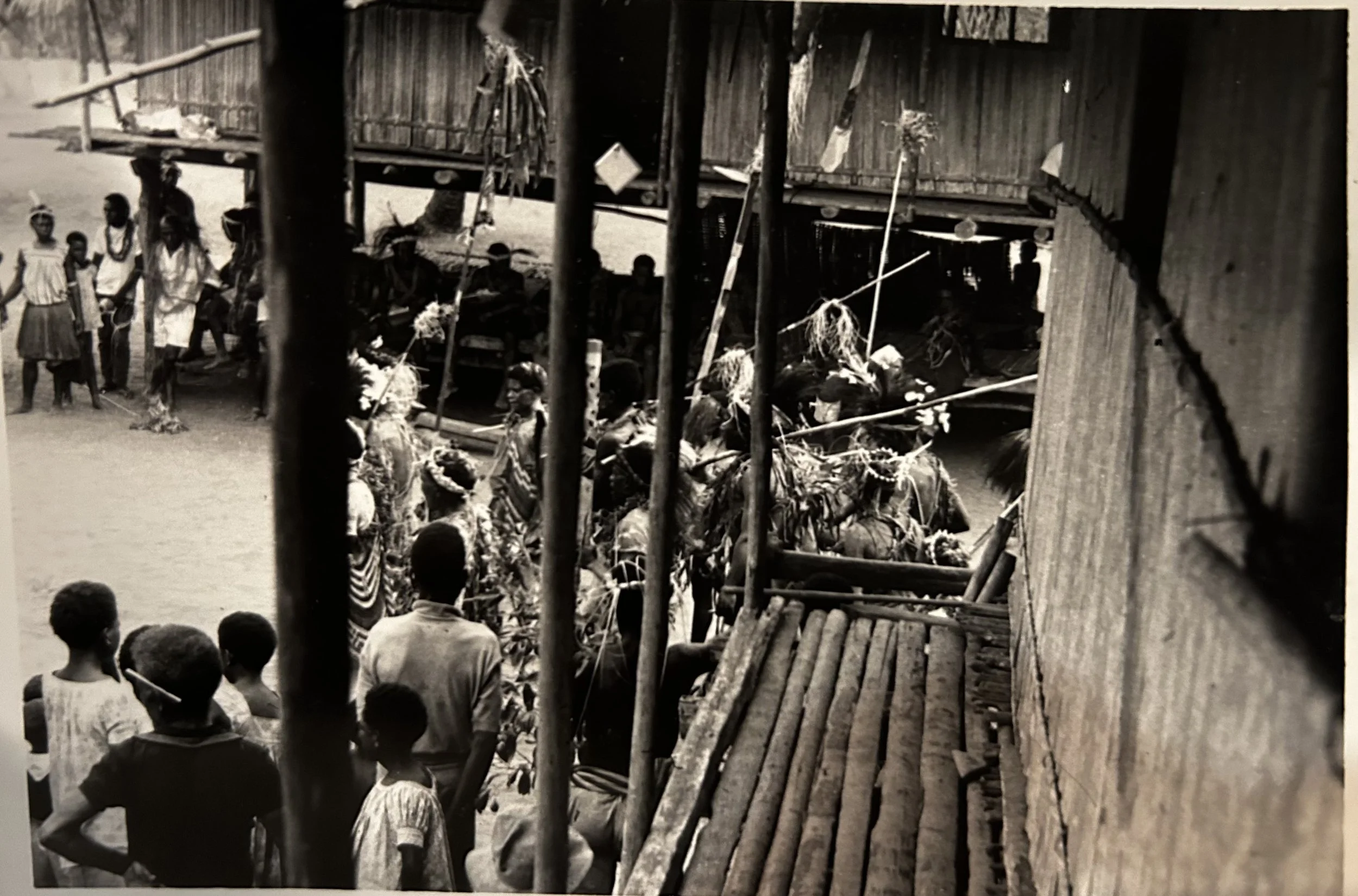

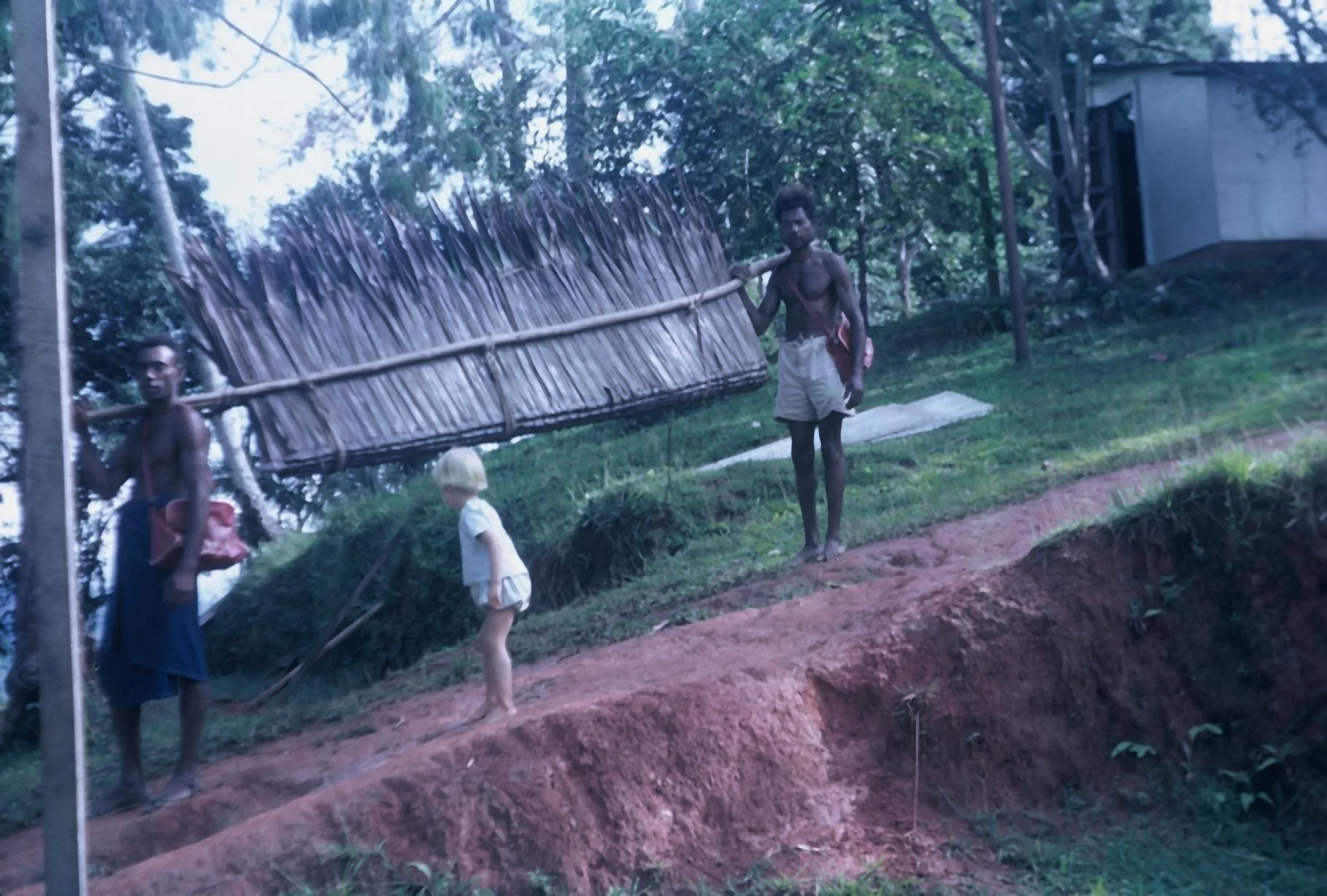
Thatching roofs as they would have had to do with the classrooms or dorms. Middle photo shows a typical floor made from bamboo.


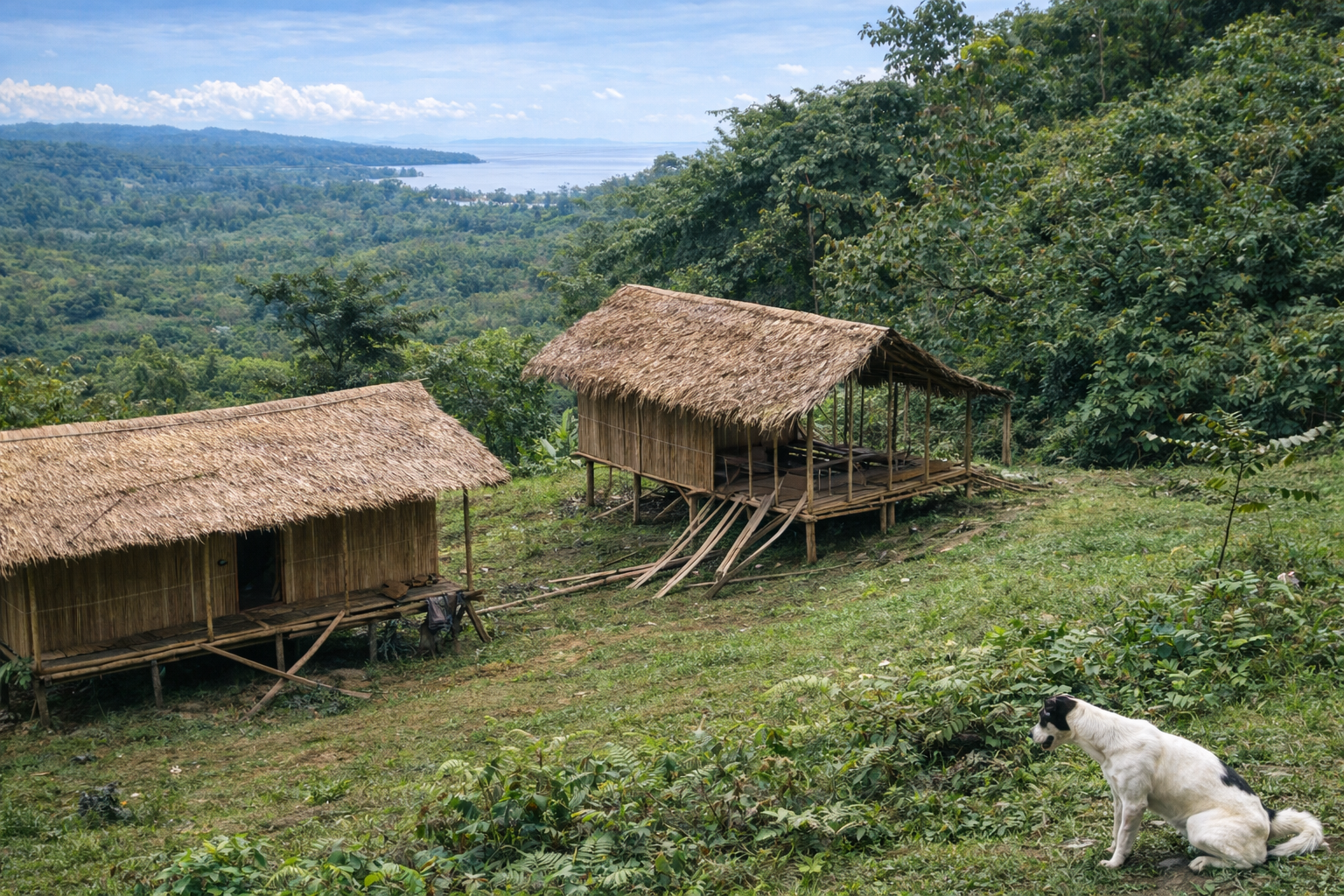
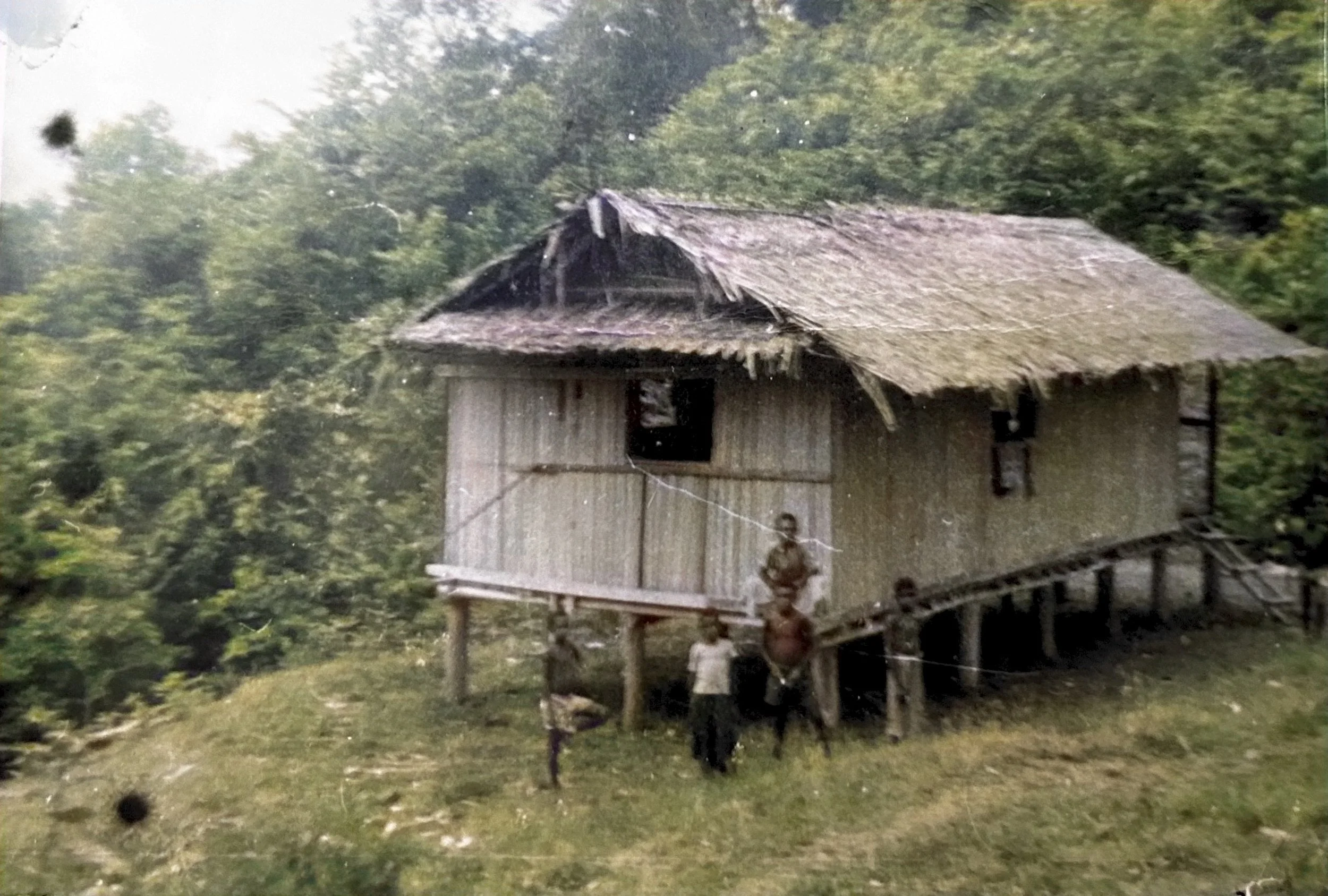
Teachers and workers houses at Malalo. On the back of the photo Ina writes “The congregation built the teachers and workers at Malalo. They have 2 rooms and a veranda. They’ve had to build places to cook outside. Now most of them have beds and tables. They’ve cut the screens to spit beetle nut out so we refuse to replace them. Al has been trying to get the houses wired with electricity and the post is there with the wire dangling. “ Teacher and student housing


You can visit the JOURNALS OF KAREN McCANN where she journals about her experiences as a short term teacher in PNG during the early 1960’s.