Malalo, the Buang Mountains, and the Work That Never Stops
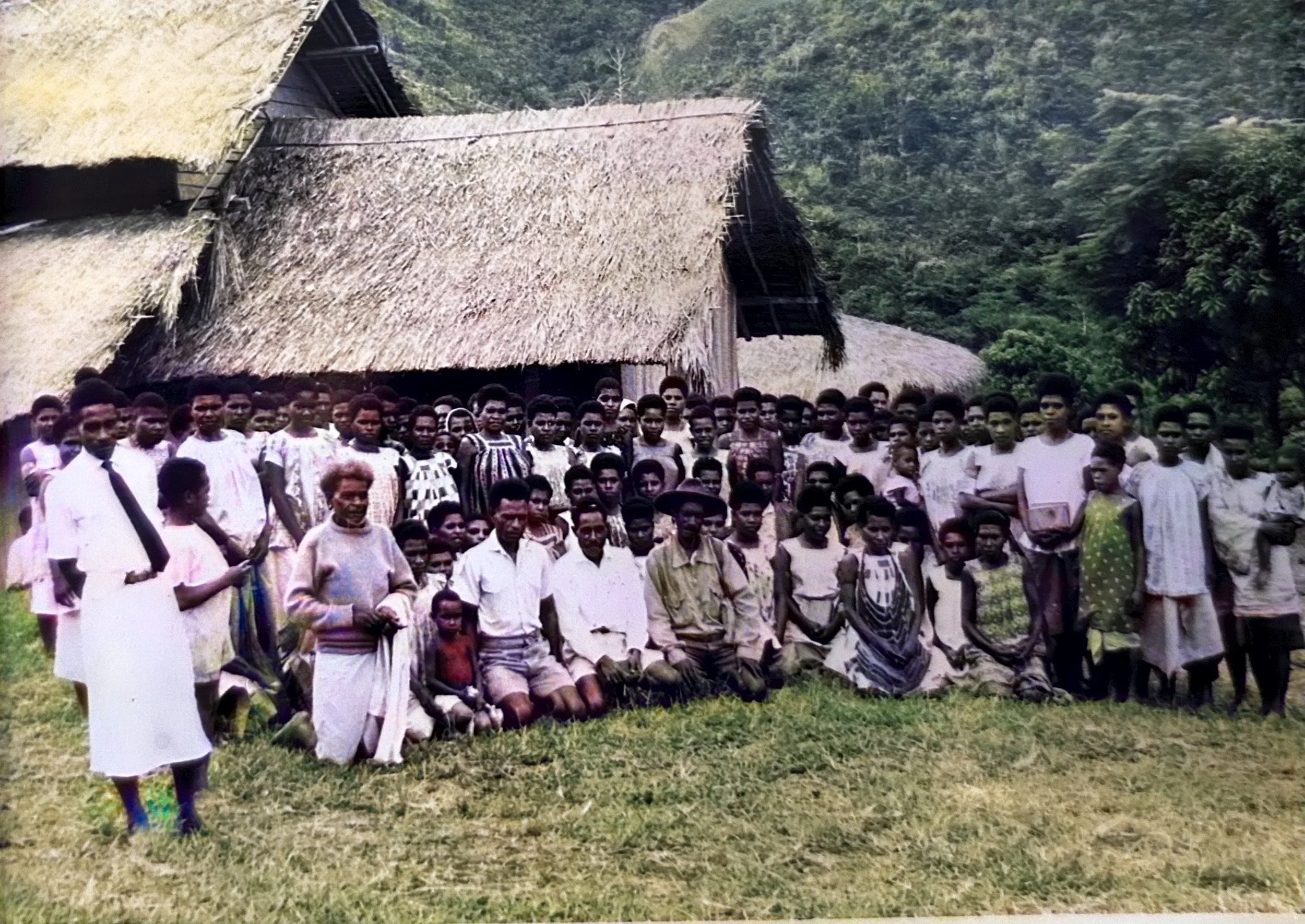
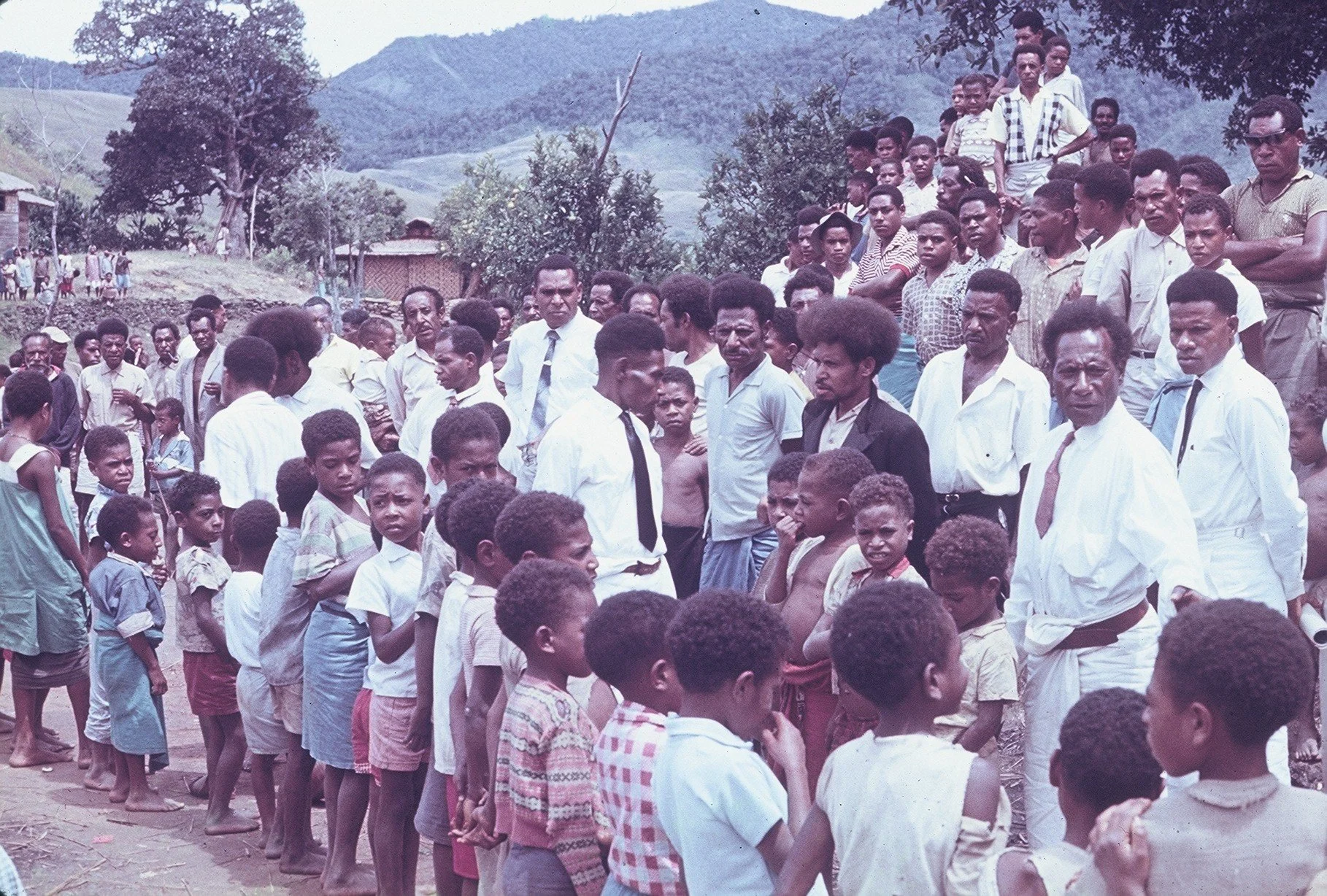
Groups in the Buangs. Pastor Onesimus in the center kneeling in the top photo and with the black tie at the center of the bottom photo
I found a file of letters that were copies of letters that Ina had written to extended family and friends. Often they are cut off at the bottom or the next page has been lost but their information is valuable enough to include them. Often she tells same stories but each one is unique and offers different enough bits of information. These letters collectively paint a bigger picture of the missionary life so I am grateful they somehow survived the many moves the Ericksons made. Ina had a big family and lots of friends including from nursing school. She adjusts what she writes to who her audience is such as more descriptive medical news to her nurse friends or gardening to her farmer friends etc. Ina was a people person and she got very lonely on the station and letter writing was a way to handle that. I indicate that this letter is a copy so there is no address and it might not be complete. ~Paula
The following is a summary of the letters for FEBRUARY 1963
Malalo, the Buang Mountains, and the Work That Never Stops
Church Completion, Circuit Sundays, and the Push Toward Education
EDITORIAL NOTE
These February 1963 letters have been consolidated into a single, readable narrative—preserving the original facts and voice, while removing repetition and merging overlapping details. Some portions come from copy-letters where pages were missing or cut off at the bottom.
OPENING: A BUSY STATION, A FINISHED CHURCH, AND THE NEXT URGENT NEED
By February 1963, Malalo had finally completed the new church—an enormous relief after months of construction. With the church finished, the mission carpenter could at last be released to tackle the next long list of unfinished necessities.
The next priority was education. The mission’s “bush buildings” for schools were temporary and deteriorated quickly in the coastal climate. Alvin wanted a systematic approach: one team to prepare posts, another to follow with building, and a final team to finish and secure each structure. The need was clear, but the challenge was deeper than lumber and nails—many parents still felt they were doing the mission a favor by sending children to school.
To encourage commitment, the mission introduced a small school tax—about a dollar for the lower grades, increasing in the higher schools. Even a small investment changed behavior: when parents had to contribute something, they were more likely to keep their children in school.
SUNDAY ON THE CIRCUIT: THE WORK OF HOLDING A CHURCH TOGETHER
Sunday was not a day off. It was often the hardest day of the week.
The Ericksons’ work stretched along the coast and into multiple mountain regions. A “circuit Sunday” could mean long travel, preaching, teaching, and managing disputes, followed by the practical realities: meals, visitors, logistics, and then the immediate need to prepare for the next week.
This was the work behind the scenes—helping a new Christian church find its way during a period of rapid cultural change, while also pushing steadily toward the long-term goal: turning the ministry over to Papua New Guinean leaders within the coming years.
--- Alvin writes from the Buang Mountains, where the work is not only spiritual and logistical—it is brutally physical. The day before, he had walked the 3,500-foot mountain hike from Malalo down into the first village, described as the main village for the entire mountain region. The next day became a full-scale circuit Sunday: about 30 confirmations, 20 adult baptisms, 20 infant baptisms, two weddings, and roughly 250 communicants, all completed in a service that lasted around four hours, with a rest taken before communion. Even after a meeting the night before that stretched well past midnight, the people treated him with generosity and honor—bringing him two watermelons, onions, sweet potatoes, and part of a pig they had killed for the festive occasion. Two young girls were assigned to cook for him. Alvin expected to spend the entire next week walking from village to village through the Buang Mountains before returning to Ina and the children about a week later.
1963 February 10 by Alvin on Su…
WHEN RESPONSIBILITY SLIPS: THE “DOCTOR BOY” LEAVES
One of the most difficult challenges in village work was developing local responsibility that could outlast the presence of the missionaries.
A young medical worker—called in the letters the “doctor boy”—asked permission to go to Lae to obtain polio vaccine for his son. Ina agreed immediately. But he did not return. Three weeks passed. When Ina investigated, she discovered he had taken a job at the hospital in Lae.
It left Malalo in a terrible position. The dispensary could not function without him. But Ina refused to simply take over and “run the dispensary,” because she knew what would happen: it would train the community to rely on the white missionary again, and it would undo years of trying to build local ownership.
She described it plainly: if the white man always steps in, the people can leave for town and make money, while the village is neglected. She understood why—town wages were tempting—but she also saw the long-term cost.
So Malalo faced a hard choice: either the congregation would need to pay the worker more (he was earning only about $20 a year), or the village would go without medical attention.
Ina compared it to raising children: if you meet every need without requiring responsibility, then when the time comes to stand on their own, they are not capable.
HOME LIFE: COOKIES, CRAYONS, AND “ME TOO”
While all of this was happening, daily life with small children continued in the background.
Paula and Tommy were “busy little beavers,” outside most of the time, barely stopping long enough to eat. Tommy copied nearly everything Paula said. He was “me too” in a small body.
If Tommy wanted a cookie, he wanted one for “Pawa.” And if Paula had one, she wanted Tommy to have one too.
On one memorable day, Tommy wrote all over the coffee table with crayons. It came off with Ajax—but Ina was not pleased.
Language was another daily delight. Tommy could say “Danny” clearly. He pointed at pictures in catalogs for hours. Anything with wheels was “twactoa.” When he wanted an explanation he demanded, “stat stat”—“what’s that?”
Paula was learning Jabem and English side-by-side, and she experimented with names. “Macow” became her word for cow. When Ina tried to explain mama cow and daddy cow, Paula immediately asked where the “Paula cow” was.
FOOD, SUPPLIES, AND A SOIL THAT WOULD NOT COOPERATE
Food logistics were constant.
Vegetables could be obtained from a plantation near Lae. Potatoes were often available. Rice was kept in reserve, and taro could be purchased from local people when potatoes ran out.
But Malalo’s soil was poor. The station could grow coconuts, pineapples, and lemons, but little else. Even basic gardening required far more effort than it would have in a richer place.
ILLNESS, CONFERENCES, AND THE RHYTHM OF LEAVING AGAIN
Alvin’s schedule was relentless.
There were conferences, followed by brief returns home, then long mountain trips—often two weeks at a time—followed by only a couple of days at Malalo before leaving again in another direction.
Even when Alvin was sick with fever and sore throat, he pushed himself to go to church. In the letters, Ina noted that he felt better afterward.
This pattern—conference, short home stay, mountain trip, brief return, and then another trip—was simply normal life.
SPONSORSHIP: THE BUDGET, THE SHORTAGE, AND THE SURPRISE OF HELP
In February 1963, Ina wrote with gratitude about new sponsorship.
First English had become a sponsor. Practically, this meant part of the Ericksons’ salary would be paid by a sponsoring church rather than by the mission board—freeing mission-board funds for expansion elsewhere.
The timing mattered. The mission budget had not been met. The letter noted that no new missionaries would arrive the next year to replace those retiring, and planned projects—including school buildings—might have to be delayed or canceled.
Then came another surprise: a family from Hanska, Minnesota—Mr. and Mrs. Harold Rossbach—also became part-sponsors. Neither sponsor covered the full salary, but the support was deeply encouraging.
Ina suggested that her parents might write to the Rossbachs and even invite them to visit, strengthening the relationship between supporters at home and the work in Papua New Guinea.
A PLACE SO BEAUTIFUL IT SEEMS IMPOSSIBLE
One of the most striking passages from this month is a description of Malalo’s location.
Ina wrote that if someone visited for just a few moments, the first thing that would startle them would be the surroundings. The station sat on top of a 500-foot hill with the Pacific rolling below. A few miles south was the Salamaua peninsula, a famous WWII fighting area.
Directly below was the coastal village of Buakup, with coconut palms and thatched roofs. Behind the coast rose mountains—first a range around 3,500 feet, then another reaching 8,000 feet. She wrote there was no level ground in sight, only dense green mountains and valleys, and the deep blue ocean.
This was the region they served: roughly 60 miles of coastline, three separate mountain areas, around 50 villages, and about 12,000 people.
THE WORK IN ONE SENTENCE
Ina ended with a simple statement of purpose:
They saw their work as helping the new Christian church find its way in the great changes taking place—teaching and preaching Christ—and steadily turning the ministry over to Papua New Guinean leaders within the coming years.
FOOTNOTES (FEB 1963)
1. The Jamisons were fellow missionaries and friends. They had traveled with the Ericksons on the same ship in September 1961 and once helped search for Paula when she wandered off in the Fijian market.
2. Vince, Ted, and Barb referenced in the letters were missionaries/mission associates visiting Malalo.
3. The conference mentioned was likely the annual mission conference, probably held at Wau, where the mission boarding school and guest houses were located.
4. Gideon was a Papua New Guinean teacher on staff at Malalo who worked with Alvin in the school.

1963 January 30 (a copy)
Dear Mrs. Coykendall,
A very belated thank you for the box you sent. We really do appreciate the interest and the time and effort it takes to get such a box in the mail.
We are really glad to have finally finished our new church, now this will release our carpenter to do some other necessary work. We’d like very much to try and put up some permanent school buildings. Most of the present bush buildings have to be replaced every few years. Al would like to get a building team going from Village to Village constructing the posts and another to follow doing the building and another to do the finish up work. The people are beginning more and more to see the value of education, though many aren’t willing to openly support them. Many feel they are really doing us a favor to send their boys and girls to our mission schools. We’ve started a small school tax that amounts to about a dollar for grades and increase in some of the higher schools. We found that the parents do more to keep their children in school when they’ve had to invest something in it then when it was free. Dropouts and pupils running away have been such a problem. When school got too hard or they were tired of working, or had been disciplined. Discipline will always be a problem, and there is very little discipline in the villages. With each changing generation, we hope this will improve a little.
I think as more of the boys and girls complete the training that is now available and are able to earn better wages, that the interest in education will continue. The churches interest in education is, of course, so that their people will be able to read their Bibles, and to teach their youngsters, but the fruit of the labors as far more reaching.
I’m very interested in hearing from some of you, about your church, families and interest. May the peace of our Lord Jesus Christ be with you all.
Sincerely, Ina.

1963 February 10 by Alvin on Sunday
Letter written by Al Erickson from the Buangs to Durward and Estelle Titus Box 224 Route1, Carlos MN USA
Dear mom and dad Titus,
Sincerest greetings from your family here in warm New Guinea. Yesterday I walked over the 3500 foot mountain hike from Malalo and down here to the first village which is the main one for this whole mountain region. Today we had about 30 confirmations, 20 adult baptisms, 20 infant baptisms, two weddings, and about 250 communicants. In all, it was about four hours although we rested before communion. The people have been very nice to me in spite of a meeting last night which went on well past midnight. They give me two watermelon‘s, some onions, some sweet potatoes, and part of a pig they killed for the festive occasion. Also, I have two young girls who are doing the cooking. For the next week I will be walking around these mountains visiting villages. I hope to get back to Ina and the family a week from tomorrow.
We enjoyed receiving your letters and have been very thankful for your continued health. It has been a great encouragement to see your constant interest. Ina was home alone while both the short term teachers and myself were at our missionary conference for 10 days. I think it was a good breather for her and gave some time to relax. She said the medical work was not too difficult during that time either. Coming back to Malalo on the Victor, one of the natives asked me if we had planned to leave. Such a story had got around. The reason, Ina had cleaned everything out of the closets in order to de-Roach them. And the house girls thought we were leaving for good.
Paula and Tom have been quite healthy lately. At our mission conference we started to feel the pinch of the recent cutbacks in the world missions budget. Of course, many missionaries here are supported from their own countries of Australia and Germany. Several brand new areas will be entered now by new missionaries. The government had forbidden white people into some of these areas up until the last year. I’m starting to use only Jabem although the conversations are pretty slow and broken. It still doesn’t mean much since I translate just about everything in my head yet.
Give all the little ones around a big kiss from us we would love to sit down and have a good conversation with you all. Thanks for the very warm hearted tape you sent us. May he who loves sinners be built up by the cross.
All our love,
Al, Ina, Paula and Tom.
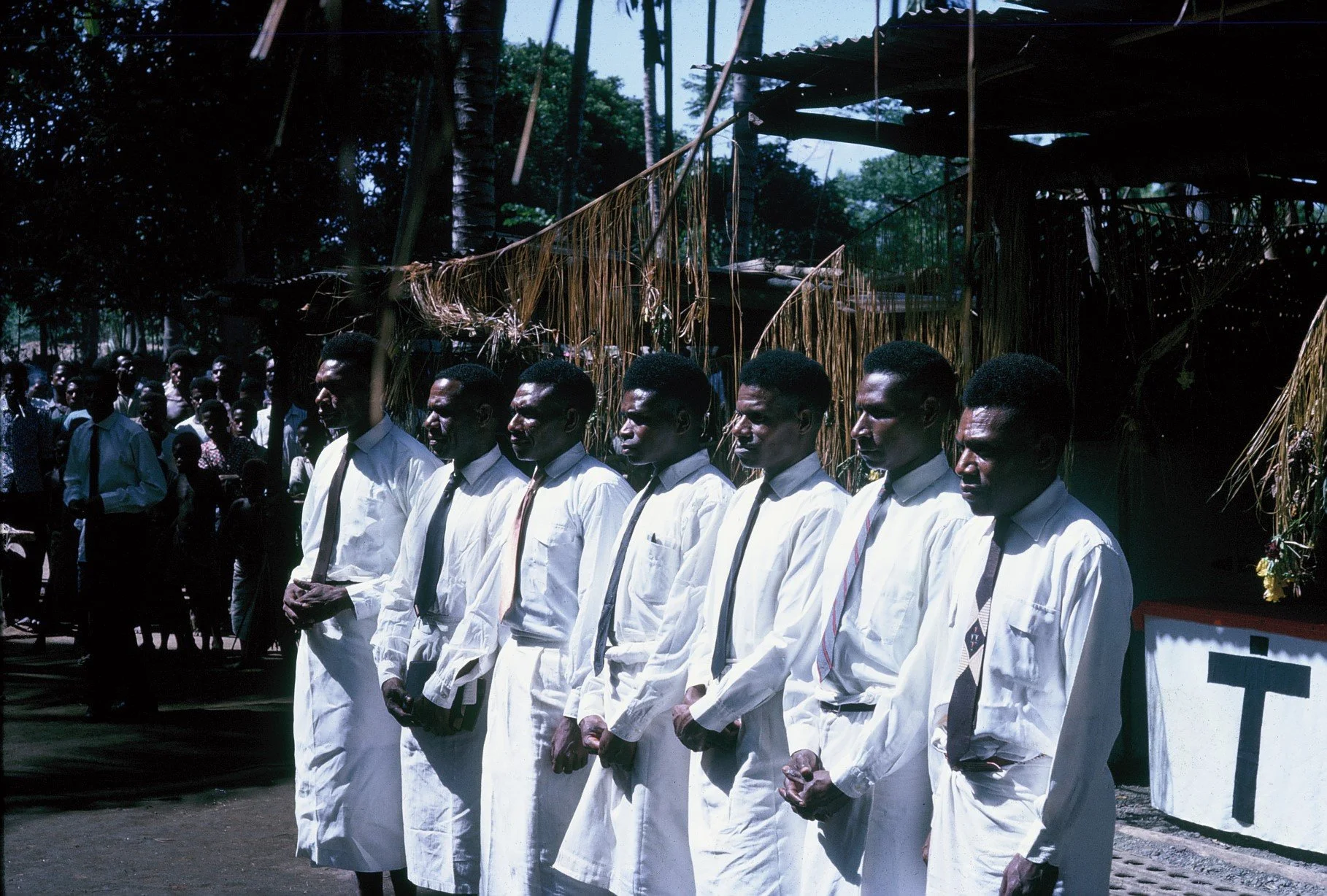

Alvin conduct Marriage of 6 couples. Government decided people needed to get a marriage license. Al had to meet with them and do this in his circle
1963 February 1 (a copy)
Dear Lowell and Jan and Linda,
I hope that Linda has been OK and that she hasn’t had any more trouble with her throat. I imagine you were really worried. Contrary to what you may believe after such a long silence from New Guinea we haven’t been eaten or any such catastrophe occurred, we’ve only been very busy.
Happy New Year and Merry Christmas.
Since the middle of November we’ve had company constantly until 1 February. And as one might expect we had many medical emergencies to keep life interesting. It really has been great seeing everyone, as we don’t have much company the rest of the year, but we have our summer vacation from school in December and January as it is the hottest time of year. People can only get away from their stations during this break, and since we have such a lovely beach at Malalo, free of sharks and crocodiles, we are pleased to have them choose Malalo as a vacation spot. People are very good about entertaining themselves as mission work must go on.

A similar beach like this at Buakup, the village at the foot of Malalo hill.
Our water ran out as we hadn’t had rain for weeks and week. Al had built a pumping station with a pump and a reservoir tank and settling tank connected to a small stream so our bathroom functioned anyway. Using the spring water meant that I had to boil all of the water we drank and used for cooking. It really was a job trying to keep enough water boiled and refrigerated. The refrigerator got so it won’t stay cold with everyone opening the door so often for water. So we had our problems.
Some of the people that came out with us were here before conference in January. It was almost like old times to be together again. Bob and Berkey got quite an assignment at conference. They have to start learning a new language and soon will be opening a new station.
Beryl had quite a time adjusting to her baby. She and Bruce love him dearly and as mother says as he gets older, they resent more and more that he has been crippled. Mother has been worried as she has been disappointed about having to go back to work into having to leave Danny at the hospital. He is in Shriners or will be on 20 February. Beryl says she feel worse if they would say there was nothing they can do for him. He seems to be a very bright child and Beryl says she can learn a lot from him because he is so happy all the time. Bruce is so good to him and for Beryl. Beryl tends to be kind of high strung, and Bruce just calmly takes everything in stride. I do believe that everything works together for the good for those that love the Lord, and do believe that their little Danny will be a real inspiration. He has so much that what he hasn’t, will soon be in the background. I guess as Beryl actually got back to work, her spirits were much better. As she sees other kids, more handicap than hers, I’m sure it will develop a better attitude. But it isn’t something that grows overnight and they need our constant prayers. It really hurts to see someone you love, so hurt and disappointed, but we are so grateful that they are Christian and that God will give the courage for each new day. The fact that they live in America so that they can get help for Danny helps a lot.
We have another short term teacher living with us and another one spending some months with us helping with refresher courses for the Malalo teachers. A new family from America came to spend Christmas with us. (cut off at the bottom of the page but I think Ina is referring to the Ramins who came sometime in 1962 and work in Adminstration in Lae. They have 3 children at this point and another is born I believe in 1963. The letter continues on the other side):

Inez and Bob Ramin family. Inez became one of Ina’s best friends. We think that since she worked in the administrative offices in Lae that Ina was able to make copies of many of these letters. It would explain why the letters are often cut off at the bottom of page rather then that she retyped these letters. Its seems impropable that this many recipients would have saved these letter and sent them back to her somehow. She had lots of them in 1963 and 64 and a few in 1965 when life got more hectic.

1963 February
Time life international LTD.
Time and life building,
New Bond St.,
London, England
Dear sir,
We have just been informed that we are to get a subscription to your time magazine for one year. We have been getting it for the past year and have enjoyed it very much, so much that we renewed our subscription for five years. It is being sent to Reverend Alvin Erickson Box 80, Malalo, Lae Guinea. The new subscription is coming to Mrs. Alvin Erickson. I was wondering if it would be possible to apply this to our original subscription lengthening it one year or if we could apply the year subscription to another magazine. Our first subscription is coming from Australia.
Sincerely, Mrs. Alvin Erickson
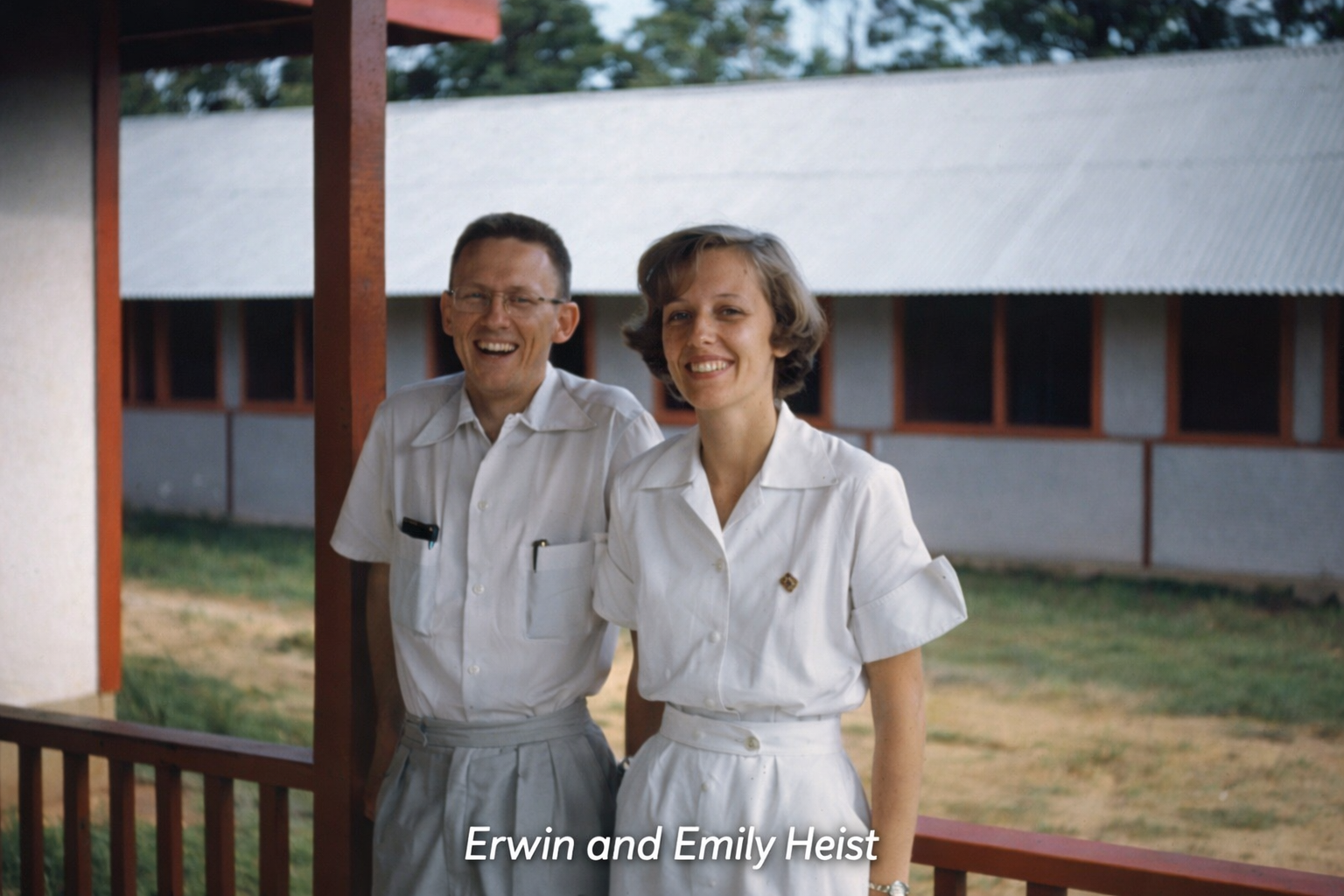
Dr Erwin Heist and wife Emily
1963 March 15
Dear Dr. Heist,
One of our Malalo students from Dregarhaffen, was hospitalized at Lae with what was diagnosed as either cerebral malaria or encephalitis. He was in delirium for several days. He has been home for several weeks and is very confused. He had been very good at speaking, English, but now doesn’t understand it at all now and can understand very little Jabem. He just walks around with a silly grin on his face all of the time. I was wondering if there was anything that could be done for him. His family has been so faithful, we would like to do anything to help them that we could.
I have consulted with Al about the price of the gauge and the humidifier and will let you know shortly. We certainly do have use for it so I’m sure this will be all right. Finally, the people have started on the new dispensary. Frieda was up yesterday, but I haven’t seen the other girl.
Sincerely Ina
Jabem is the common language spoken in this part of New Guinea. The other missionaries that are in the Jabem district at the time according to Alvin is:
Lae or Jabem District, New Guinea Missionaries
Karl Hozknecht Kaiapit German
Walter Eidem Aseki German
Hans Maurer Lae Wampar German
Hans Fink Kaintiba German
Hans Stief Deinzer Hill German
Christoph Michold Lae city German
Colin Rohrlach ? Maybe Deinzer Hill, Australian
Jack Reents and Shirley Mumeng American
Fred Scherle and Edna, Malalo, Mumeng, Social Service American
Harold Brown and Carol, Lae Wampar American
Michael Bear Translator into Jabem, Logaweng, German
Al Erickson, Malalo, Logaweng Seminary
This is from his memory so may not be complete.

1963 February 7 (a copy)
To Jan and Therm Wettland,
We’re sure glad to hear that you had a much healthier year. You people surely have had your share of trouble. We all have been quite well. Al is in need of a vacation. He is pretty tired, thin and discouraged. It hasn’t been real easy for him to move in and take over station with no orientation, and not knowing the language. He is really making good progress with the language. I have been poking along, having a hard time, making myself get serious about it. I can communicate enough to get myself understood, but Al is real fluent. He has had several sermons in Jabem and I thought he done real well. It is always such an exhausting experience trying to get such deep meaning across in such a halting vocabulary.
I think this next year will be a little more interesting, as I believe we can move ahead a little. Until we could communicate in their language, there was very little we could do. The misunderstandings have been so hard to cope with. Their thought patterns are so different. When we say something it has an entirely different meaning then when they say it and vice versa.
God has been very good to us and the people have been very patient with us. Encouraging our Jabem constantly correcting our mistakes. It makes it kind of nice, because they are trying to learn English as we are trying to understand them. It is more difficult for them. We won’t have to think of school for a few years yet but as you know the time slips by.
I can hardly believe that has been six years, since we are at St. James to witness the marriage of Mr. and Mrs. Wettland. Do you remember Ted Hilpert? He came out with us. He is going to be married and December. He has decided the place for him is not in New Guinea but back in the states. He hopes to get some more education and then go back into the parish ministry. We’ll miss having him out here, but I do admire his courage, and facing the fact that this isn’t his calling.
You sure have a handsome family. When you get them all cleaned up, I bet you’re real proud of them. – Or don’t your kids get as dirty as mine. I really wonder how they can find so much dirt. Most of the time, I don’t even want to claim them as they are so dirty.
We are having a hot dry season. We’ve been breaking records. It hasn’t rained for going on six weeks. The longest it has ever been before this two weeks. Everyone’s gardens have been burned be on repair so our people will have to go on a long fast. We hope and pray it will rain soon they have no way of irrigation – most of the gardens are on a 80° slope. Our water tanks have since been dry. I’m very thankful that Al got a pumping station fixed so that we could pump water from a stream when our tanks are dry. There is no water table, so we can’t dig. You just go down and down and down and find rocks. Thank you for writing. I’ve always am so glad for any news for anybody that I know. Where is Eileen living? Is she happy? God‘s blessings to you.
Love Al, Ina, Paula and Tom.

A garden either prepared for planting or is done and left for eight years before replanting
1963 February 7 (a copy)
Dear Stan and Katie, (Stan Quanbeck married Katie who was Ina’s roommate at Fairview Nursing School in Minneapolis. She is in a photo in the Summer of 1961 posted on the blog. They went to Madagascar)
Our sincerest congratulations Stan, both Al and I think you have chosen a wonderful wife. Our best wishes to you, Katie. From the reports I hear you haven’t done too bad either. I’m sure if you are anything like us, soon after the honeymoon is over your rose colored glasses, come off and you wake up to the reality of the situation. That you each have married people with shortcomings and selfish desires just like yourself. Al and I were both such independent people that we had an awful time trying to bend to the desires of the other one. If someone didn’t want to do what I want to do. I simply did it alone, and the same for Al. I had a very stubborn nature which didn’t add anything to the situation. After many tears, evil thoughts, and finally prayer, we’ve gradually learned to live with our differences and accept them if not to resolve them. We have been very grateful that our marriage was founded on Christ, that we had somewhere to go to help our differences, that he could help us humble ourselves up to say “I’m sorry “. That his abiding love continue to be with us even in our neglect to him. I found devotions was much more difficult to maintain after married than before. We really have to work to keep this apart of every day. We are very grateful for the children has blessed our home with. May his love be the center of your home.
I’m glad that the seashells reached you and not too bad to shape in case you can’t make out that one piece of material is supposed to be it’s supposed to be a toaster cover. My toaster is so small that I was trying to make yours a little bigger. Well, I got it quite a bit bigger, so I tried to make it a little, smaller again. Well, anyway, if you put a drawstring around the bottom, you can use it for a bottom bag.

The Ericksons would often purchase seashells from the locals and send home as gifts
Thank you so much for the color for my memorandum of Minnesota, the lovely pictures of snow make me so lonesome for a good old Minnesota. Speaking of Minnesota would you please tell me who is the governor. Everything I read they say they are still deciding. But really, they must’ve decided by now.
I’m sure you will find work quite different. I really think it is hard to find a place that quiet compares to Fairview. It must be a tremendous change for these people to accept themselves as something less than they formally were. In America, we have geared everything to comfort and pleasure, not really facing reality and responsibility squarely. I’ve concentrated on being tactful, psychology has concentrated on blaming all of our faults on complexes, early training, everywhere, but within ourselves. I think learning to accept our shortcomings, face reality that this is the way it is, only with help of God can we overcome the shortcomings. I don’t know if you know what I mean or what I’m driving at, but I think our hardest adjustment to the mission life was to accept the fact that we had to face things to accept responsibility for our own actions. You had to tell people when they are wrong and have to be unpleasant at times. We’ve been so prone to glossing over ugly truths and trying to make difficult easier to take but I can see that this is a crippling attitude.
We certainly do have a challenging job before you to help these people see that the world hasn’t stopped because they have a handicap, but fortunately it goes on, and there is a place for them in it, if they are only willing try and to help themselves, and let God help them. Enough sermonizing. You think I was the preacher in the family.
If you should run across some forceps or a vag speculum or a blood pressure cuff that is old but usable that nobody wants I could always use it in our dispensary. Hint hint.
Do you remember the Scherle’s? Fred has been having so much trouble with his back that he will be coming back to the states for surgery at Rochester, Minnesota. Estimate that he will be gone at least three months. I don’t know if Edna will be going along.