Challenges with everyday life.

Typical coastal village
The following is a summary of the letters for MAY 1964
When Everything Happens at Once
Malalo Mission Station
Malalo in the Rainy Season: A Narrow Margin
By May, the rains have settled in. The air cools slightly, breezes come more often, but humidity clings to everything—paper, clothing, bedding, food. Tin roofs drum through the night. Paths slick over. The hill between Buakup village and the station becomes treacherous, yet it is climbed daily without comment.
Malalo remains what it always is: a hub perched above need.
Boats still dictate access. The Victor comes when tide and weather allow. Lae remains three hours away by sea, longer when repairs or forgotten parts intervene. The dispensary stands newly rebuilt, solid at last—but permanence brings expectation. When people hear there is a cement floor, light, screening, and proper equipment, they come sooner, later, too late, and sometimes all at once
Background context with Malalo
.
Alvin Away, Always Needed
Early in May, Alvin is again down the south coast—a region Ina knows well by reputation and letters: spiritually thin, economically fragile, villages stretched thin by distance and discouragement.
Al thrives there. He enjoys the walking, the conversations, the preaching. What weighs on him is not people but machinery—tractors, pumps, generators that fail at the wrong time. When the Track-Grip goes down with a flat tire, it becomes emblematic: a half-hour repair stretched into six weeks by broken pumps, forgotten errands, closed shops, improvised fittings, and yet another tire failing halfway down the hill.
Ina writes it without bitterness, but the accumulation is clear. Here, nothing fails alone. One broken tool pulls ten other tasks down with it
1964 May 4
.
Birth at the Dispensary: Order Against Instinct
One night, a woman arrives from a village two and a half hours away, seven months pregnant, labor stalled and uncertain. She has already had six children. The village midwives expect this one quickly.
Ina does not.
She prepares carefully. An old army hospital bed—left from the war—is brought down. Rubber sheeting is laid. Receiving blankets and crib sheets sent from First Lutheran are unpacked. A small basket Edna Scherle once used for babies is pressed back into service. Mosquito netting is draped. Forceps, clamps, scissors, bulb syringe, gloves—everything laid out deliberately.
The village midwives hover, impatient. Their hands itch to push and pull, to hurry what must not be hurried. Ina watches them closely, stopping each attempt with quiet firmness. She explains as best she can, using hands, gestures, demonstrations—showing that the body must open before the baby can come.
Labor stalls again. Church begins.
Ina sends her children down the hill, leaves Kristi sleeping, returns to check the mother, then dashes back up the hill for her baby, then down again with Kristi and Tommy, setting them in a corner of the dispensary with books sent from home.
The husband asks where they can stay. Ina tells him she has asked for a bush house for over a year. He promises they will start next week. Only need reveals urgency.
When the old women are finally shown—visibly—that the cervix has opened enough, excitement replaces interference. Hands stay back. The birth proceeds.
A healthy baby boy is born.
The doctor boy tends the infant. Towels sent from Minnesota are used to clean the mother. Gratitude settles into the room. It has worked—not because instinct was ignored, but because it was guided
1964 May 3
.
Illness, Loss, and the Limits of Help
Only days later, another girl comes—seven months pregnant, pain deep in her abdomen. Ina puts her to bed, gives progesterone and phenobarbital, hoping to quiet things.
Labor begins after midnight.
When the membranes rupture, the fluid is dark, ominous. Ina knows immediately this will not end well. The uterus begins to prolapse. They work desperately to prevent it from coming out further. The baby is limp, hydrocephalic, badly macerated.
Ina attempts resuscitation. Mouth-to-mouth. Then a tube. Coramine. Heart tones flicker and fade.
After two hours, she must stop.
Later, she will realize it may have been congenital syphilis—something that could have been treated if known earlier. Explaining it is difficult. She tells them only that it is “a sickness in the blood.”
This is the first such case she has seen. She knows it will not be the last.
The weight of this stays with her long after the letter ends
1964 May 7
.
Pneumonia and Persistence
As May presses on, Alvin falls ill.
A heavy cold becomes pneumonia. He had continued traveling, walking, preaching—taking his medicine irregularly as usual. Now Ina has him in bed, administering penicillin injections, sometimes needing someone to hold him still.
Ten injections bring little improvement. Streptomycin follows. Finally, Terramycin. Slowly, he begins to respond.
Ina opens the dispensary again while nursing her husband. Then a child is brought in comatose with meningitis. The Victor is beached for cleaning. No boat can come until morning.
Ina treats as best she can—penicillin, sulfa, suction, artificial respiration. The child dies.
The father had painted the church and the dispensary. Ina tells the family to disinfect, boil clothing, burn mats. They forget in their grief. She sends a nurse’s aide to their village the next day to see it done.
Another infant spikes a fever. Malaria or meningitis—hard to tell. Ina waits, then gives sulfa with a heavy heart. The fever breaks. The child lives.
This is the margin Malalo works within: minutes, judgment, no backup
1964 May 24
.
The Dispensary as Promise and Burden
Mid-May, the new dispensary is dedicated—cement floors, copper roof, screened windows, light and air. A gift once given to Fred Scherle now bears fruit here.
For the first time, women can be delivered in a clean space. For the first time, emergency care has walls that do not collapse.
Convincing people to come remains difficult. They arrive early only when frightened, late when hopeful. Often too late.
Still, this building changes expectations. And expectations bring pressure
1964 May 12 summer batch
.
Leadership, Money, and Trust
Money remains the quiet strain beneath everything.
Teachers, pastors, evangelists—over seventy church workers—are paid by the congregation. School fees are introduced reluctantly. Medicine is sold, not given, to preserve dignity and sustainability.
People still believe the missionary “has everything.” Fred Scherle’s system remains crucial: money never passes through missionary hands. Treasurers report publicly. Accounts are read aloud.
Even so, suspicion lingers.
Government wages distort expectations. Young people leave villages for salaries and do not return. Elders carry the burden. Taxes arrive. Village treasuries are emptied to pay them, leaving schools unfinished.
Ina writes it plainly: the system strains, but it holds—for now
1964 May 4
.
Children in the Midst of It All
Throughout May, the children grow.
Paula constructs sentences shaped by Jabem. Tommy insists ketchup is “locked.” Kristi creeps backward, stands proudly, sings loudly, blows food when sung to.
They pack toys and announce they are “all going Lae now.” Every cake is possibly a birthday cake. Every moment is new.
Ina treasures this without indulgence. Childhood here is resilient or it does not survive.
The Cost and the Gift
By late May, Ina reflects quietly.
They are not starving. They are not naked. They have electricity at night, a kerosene refrigerator, ice cream when conditions allow. They have more than most.
And that knowledge brings responsibility.
She asks for prayer—not for relief, but for wisdom. To share wisely. To love steadily. To walk humbly.
She writes without regret: we shall never regret the years we spent here.
May at Malalo does not resolve anything.
It reveals what is already true.
May’s Shape
May is the month when everything happens at once.
Birth and death.
Illness and healing.
Faith tested without spectacle.
Malalo does not soften.
But it proves itself capable.
Sources
May 1964 letters by Ina Erickson from Malalo Mission Station and Yagaum Hospital correspondence
The following are the actual letters for May 1964
1964 May 3. (Ina oversaw a tough maternity delivery)
Letter written by Ina Erickson from the Malalo Mission station to Martin and Willa Tonn, Route 1, Box 224, Alexandria, MN
Dear Martin, Willa and family.
I’d rather belated happy birthday to you, Willa, and a happy birthday to you, Martin, and a happy birthday cake to you, Martin, Junior Fritzie from Paula, Tommy and Kristi. Be sure you get the frosting in your hair and all over your clothes and face and hands spritz as it tastes much better that way – take it from Tommy he ought to know.
Al is down the south coast. That is one of our poor regions spiritually as well as economically so he could well spend a lot of time there. I think if we don’t have a short term teacher sometime, then we will just go down and live in some of these villages for a while. Visits make a little break in the monotony of their lives.
We had an interesting day today. Last night a woman came from a village which was 2 1/2 hours from here. She had been in labor and then it quit. They were a bit concerned for her. This is her seventh baby. It appeared that it was a bit early, but the position seemed all right. I gave her a pain pill and told her to go to sleep for a night and strongly enough she obliged. I was a bit surprised when I woke and she hadn’t done anything. Then about 7 AM. my nurses said she had started again so we made the delivery room ready.
I took a bed down that we no longer use, and it was an army hospital bed left over from the war. We had gotten a double bed made in Lae, but I hadn’t taken a mattress down, so we took one down, and we had some rubber sheeting to protect the bed with that. Edna had left a little basket that she had used for babies. So we put some of the crib sheets that First Lutheran had sent out with receiving blankets and a mosquito net. It really was fun to have all the nice things. I got out our ‘OB’ packs, the forceps, scissors, Hesseltine clamps, and the bulb syringe from Burl pack, and of course, rubber gloves. And we waited. She had a fairly good contraction, and when I checked her, she was only 2 cm. O station. Now what made it interesting is that I had about four village midwives helping. With having had so many babies, they thought that she should have it right away. So they begin pushing and pulling on the poor ladies abdomen. I tried to explain that they just had to wait a bit as she wasn’t ready to have her baby yet. They had awfully itchy hands, but with my eagle eye on them each time they started pushing they were a bit hesitant to do anything. Then it all stopped, and it was church time. I told her to go to sleep again and got all my kids ready for church and sent them down. The girls from Bula came for dinner. I had a roast in the oven, so there was no sweat over dinner. I knew that they were coming so told my house girls what to fix and they can proceed fairly well. Boy, it’s pretty nice having servants. One of the village women were staying with her. We only finished the literature of the service, and I got so uneasy I had to leave. I had put Kristi to sleep in her crib and left her, so I wanted to check on her too. Tom came up the hill with me. I looked in on the woman and she was having pains again so I dashed up the hill and checked on Kristi. I got Kristi, her Tommy chair, and Tommy and took them down to the dispensary. I sat them in a corner with little books that you people sent and they stayed quite quiet. The lady had a little bit of fresh bleeding, so I was a bit uneasy. Our boat captain had gone to his village and had not told me the other boy that can run the boat if he had to. But he had injured his toe and his wife, one of my former nurses, said that she had his foot elevated, and that when he walked, it would bleed. So that meant no boat if we did run into trouble. Dear God, please help!
Upon checking her again, she made a little progress, and I tried to stay with her as the village ladies insisted in her increasing pushing. When church was finished, and I wanted to get dinner on the table so we did have gas and I wanted to feed the kids. So, I told the doctor boy and the nurses aid that she wasn’t ready to push, and that if the old ladies insisted on pushing, that she would push the whole uterus out and kill both the mother and the baby. I said if the old ladies insisted on doing it, they should tell me. I thought the lady was a month early. She didn’t have a clue how long she’d been pregnant, but the baby looked small.
We had just about finished when the nurses aid came in all excited. She said they had the lady down on the floor and were pushing on her. In the village they’re always on the floor. This is a new experience to have her on a bed. I went tearing down there really in a huff and I had every intention of telling them to take the lady and move out. If they didn’t want to do things my way, then I wasn’t going to help. But then I got down there and the lady was back on the bed and all of the ladies were standing around as innocent, as could be. But I’m sure the nurse was telling the truth. I checked her again and told them all or rather showed them with my hands that she was about 8 cm. I tried to explain by demonstrating with the opening of the sock had to open this much, before they could push the baby out so they were all excited when they saw that she had made so much progress. Then they were pretty good about keeping their hands out of what was supposed to be clean. I told one old lady that she should wash her hands like we were doing. I was hoping that maybe she’d think of that when she helped deliver one back in the village. Phyllis, Glenna, and June the teachers from Bula, wanted to watch the delivery, and that lady agreed so they all came down. When every time I examined her. I always tried to tell everyone what I found, and the old ladies really look like they were taking it all in. Thank God all went well, and we had a real nice baby boy. The doctor boy took care of the baby and we could wash the mother off with towels from First Lutheran. I have been trying to get a house built for the people to stay in when they come from a long ways off but no one is interested. The husband wanted to know where they could stay and I told him I’ve been asking them to build a bush house over a year. He said that next week they start as they already cut the wood for it. They decided to stay with some of the people.
Our Dr boy is still with us. I found out that he won’t get paid by the government as we thought $160 a year but only the $15 a congregation pay so we will have to go to Lae and find out about it. He seems like a good boy. The government didn’t want to let him go and I’m not going to if I can help it.
Have you started your house yet, I’m sure you are anxious to get settled again. It is hard being separated. I do hope that mark can get transferred soon. You really are such a busy people. Just makes me dizzy trying to keep up with you all.
We had the bad duty of breaking the news to one of our leading churchmen, Anam, that he has a very advanced case of cancer. We really will hate to lose him. He really has meant a lot to Al. Being able to tell him a little of what their people think. He knows how to tell people when they’re wrong, including his missionary, but he is a wise old man and has gotten all five of his kids in school. One is going to be a doctor, one is already a nurse, and another boy is at the top of his class in one of our higher mission schools. If this man had been born, a generation later, he would be one of the chief leaders in New Guinea, I’m sure.
I hate to miss out on Fritz‘s baby hood, he must really be a horse if he is 30 pounds. Tommy only weighs 30 pounds and he isn’t little. Paula has gained it back after being sick, so is a little rounder than she was.
We love you all. Thank you very much for your faithful prayers. Please pray for Anam our elder with the cancer. We do enjoy New Guinea more and more. We look forward to coming home.
Love, Al, Ina and kids.

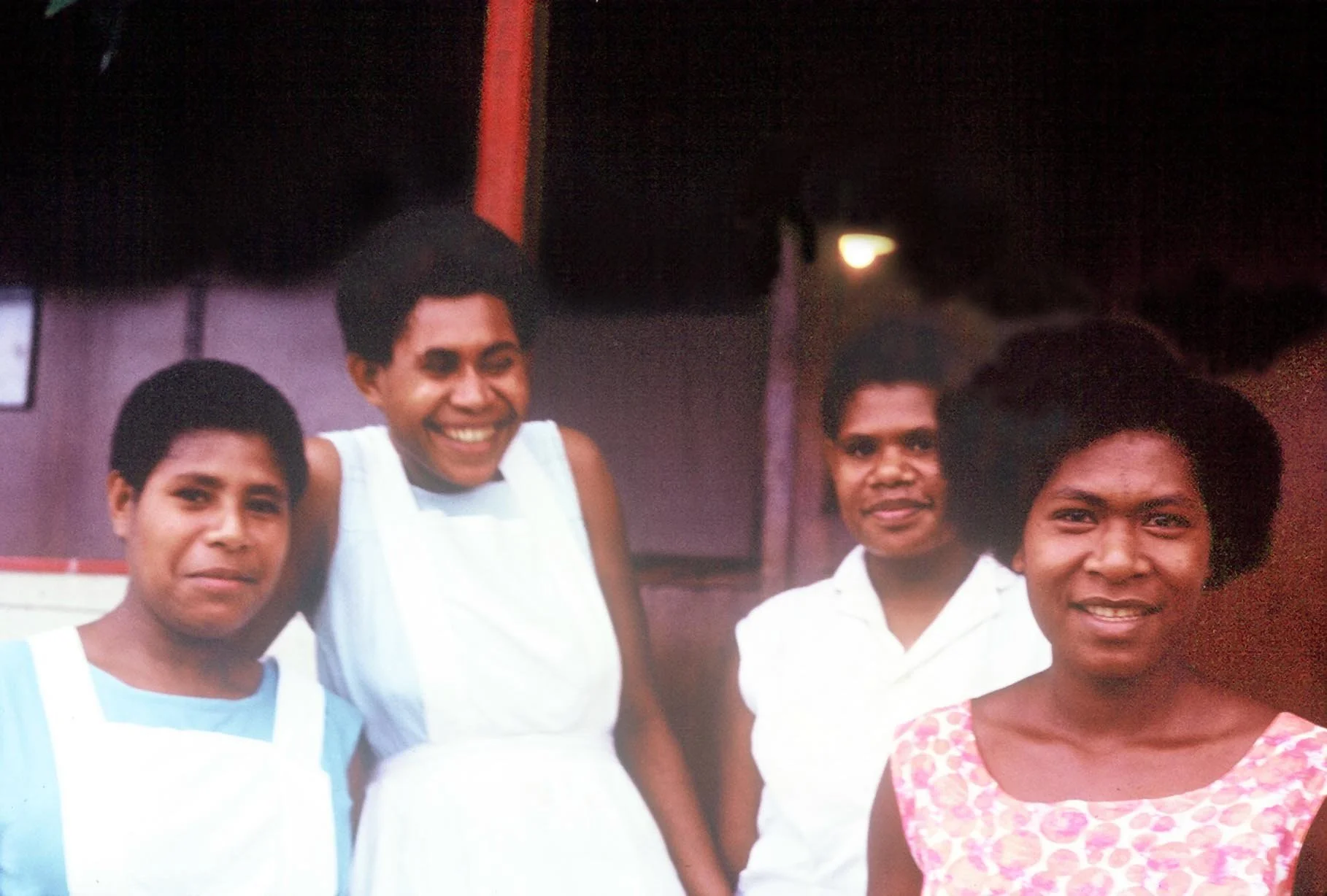
Ina and Paula with teachers from Bula School. Unknown, June Prange and Phyllis Engebreitson and nurses at Malalo
1964 May 4
Letter written by Ina Erickson from the Malalo Mission station to Durward and Estelle Titus Box 224 Route1, Carlos MN USA
Thank you so much for your very warm and encouraging letter mom, we really do look forward to your letters a lot.
Al is down at the south coast. He always enjoys these trips so much. He says if Mission work just involved that, he has a really found his niche. Running the station with all of the machines is what gets him down. We had a flat tire on the Track Grip. First he found the pump was broken, a carpenter, had broken it, at several months ago and hadn’t bothered to mention it per usual so we sent the pump and the tube into to get it fixed. For three weeks Metegemeng kept forgetting to bring it back, so I told him he’d have to carry everything up the hill if he forgot for another week. He remembered, but he found the shop closed for another week and we got the tube and pump, but the pump didn’t fit the tire and they hadn’t tried it or blown it up and Lae, so they improvised and got all the tire pumped up and drove halfway down the hill with the tractor and another tire went flat and there it sits. It would only take a half hour to fix but here it is a six week job. But then we have the peace and quiet and freedom from racial problems out here.
My elation over our good Dr boy didn’t last long. This morning he didn’t show up for work. Upon inquiring what had happened to him I found he had packed his bags and left. No word of explanation so no one even bothered to say so until they wanted help and I asked them where the Dr boy was. I get so exasperated I could just tear my hair out. Of the kids that have gone through mission, school and medical training and you can’t get anyone to come back to the village to work. I really do think it would be better in many ways not to be here, then they’d have to bear the responsibility or drown.
Metagameng disappeared after he got back from Lae on Saturday and I haven’t seen him since. He didn’t ask for any time or if he could go to his village, so there will be another row and if he gets back. Some people are expecting the Victor to pick up fish tomorrow so if he doesn’t show up, I may just pack my kids up and take it. The fellow that helps him really injured his foot when some heavy roofing iron tore the skin off of his first two toes and it’s been bleeding quite heavenly. I don’t know if he will be in shape tomorrow or not. I guess we will just have to wait and see.
Our set of twins are still living. I wrote to Mrs. Ernest, and to Edith G. The time in New Guinea is rapidly drawing to close where the people are willing to bear our cargo. At first they were odd at the things that Whiteman had, and hope that by becoming Christians that they would inherit all these things. It has been pretty disappointing, during the war the American ships came in, bringing such an unlimited supply of things, food, clothes for the soldiers, and in some areas, people are waiting for their ships to come in bringing them things. We labor trying to teach them that these things come from hard work. They work hard in their gardens, but they still don’t get these things. We found that when we try and give away like school and medicine, they, then think they are ‘something nothing’ as they say in Pidgin. So we have had to start charging some school fees. They think that this all goes to missionary for his many things. Also teaching them to give offering in church. They fully believe that it all goes to the missionary, so why should they give to the missionary when he already has so much. Fred wisely set up a system of taking care of the money, so that he never touched it. It all went through the hands of a church treasurer, and the pastors, so that there is checks and balances, so that, no one is tempted to help themselves. Try to point this out as many people will not be convinced of anything they don’t want to be convinced of.
At Mumeng, near Gurakor, we almost got into the thick of it. Soon after Fred arrived, they found that there was much money unaccounted for. The missionary there did all the bookkeeping for the congregation and kept all of the money. Well, another native fellow was around, collecting his fees for anything that he could think of reason for and then pocketing the money. Al had to answer for all the money taken in while we were there. But any money that people said they’d given for different funds and didn’t appear in the books, and no one knew of the missionary, or the other fellow pocketing the money. Unfortunately, Reverend Harolt’s wasn’t there to explain, until just what had come to him, and what had not, so it was just the word of this fellow. Many of the people believed it was the missionary, but Al could vouch for the funds he had not received that people said they had paid, and it showed that the native fellow had pocketed quite a bit. But there again, the people will think that they want -no matter what proof there is to the contrary. So here we have nothing to do with the money. It all goes to the church workers.
Actually, the congregation has done better this year than last year. They have met most of their obligations. They pay for the salaries of all 30 uncertified teachers, five pastors, and 40 evangelist, and the other church workers and carpenters. The treasurer reports are read to the people so they can see, if they want to, where their money goes. The young people that come back to the village to help their own people after they have been educated, have been very few. The old people have to support the schools and help the teachers with their gardens, and the children go out and make good salaries and the villagers are left to do the hard work. If we can assess the young people that go through school and make good wages for their education to take the burden off the villagers, I think the discouragement in the villages would lift a little.
The government now makes the people pay taxes, about $6.50 a year for most of the able-bodied villagers. So they are more eager to seek employment to be able to pay their taxes. There is one reason why the sawmill is picking up. They may not seem like a big tax, but to some people that might be as much as they make in a year. One village has a school building almost completed. They had a village treasury that they were building it with. When it came time for taxes, they took the money from the treasury and distributed to the people that needed to pay taxes. Now they can’t finish their school and the old one is falling down.
My house girls surely have been good. The children really like them. I hope they don’t quit now, in spite of all my complaints, I don’t want people to think that we or anything because we are far from it. We have very adequate and comfortable living conditions. We can get fresh meat from a mission owned plantation nearly every week or two weeks or when every we need it. We have a kerosene refrigerator that works very well and has a large freezing unit so I can keep meat a long time. I can also make ice cream in this and now I have a stove that works very well. We can get all of the potatoes and canned vegetables that we want and now can even get shortening from the states. We have electricity in the evening. Often, we can get fresh vegetables from the people and some from a highland station that has gotten its people growing vegetables to sell to the towns. An airline flies things to Lae, and is reasonably reliable, so we can get them from there. We get our mail now twice a week and can listen to the radio so hear current news and I have plenty of clothes. In fact, it is embarrassing for us to have so much among people that have so little. I really would like to have you discourage, sending, or having other people, send things for us personally. I hate to even have to collect a salary, it seems we do so very little to earn it. I feel guilty about that.
There are many building projects that really need to be undertaken. Putting up permanent buildings as people just don’t have time to put up bush buildings every three or four years anymore with all the men of laboring age go off to towns. But of course they cost money and if people don’t try and raise their own money, then they don’t take any interest in the upkeep and keeping their children in school and if you wait for them to do it, you wait forever. So we pray that the Lord will guide our ways that all other goals are secondary, and that our first job is to proclaim his name above all other names and walk in his peace and love, fearing to fend him, seeking always to serve him.
We really can’t complain of any major tragedies, not loss of life or limb in our families, and we certainly aren’t starving or naked. We pray that God will teach us to share wisely with our New Guinea brethren.
I get such a bang out of the children. Paula and Tommy are always coming up with some unexpected remarks. I was down at the dispensary and when I came back, Paula was calling and calling. I asked her what she wanted. She replied ’I didn’t look you, so I tell you’- in other words, I didn’t see you, so I called you. I have to work and work with Paula on her construction of sentences as she gets the oddest combinations. (Probably from speaking Jabem). Tommy seems to put better phrase it together, but not as long ones as Paula tries.
Here, all the tin cans of food have to be double sealed because they spoil so fast and the cereals get worms and bugs in them so fast. Tommy is such a ketchup boy, and when he got the bottle, it was a new one that was unopened. He got the big white cover off but underneath there was a cap like a pop bottle and he said ketchup is locked now. He still always puts T’s in place of his S’s so he ‘hab’s some ‘tupper’ and goes ‘twimming in his twimming toop’. Every once in a while, they will pack up their toys and announce ‘all going Lae now’. Every time we have cake, Paula wants to know if it is her birthday cake and if she can open her presents now. Kristi is getting more and more mobile, she can make a little progress on her tummy backwards. Oh, does she ever like to stand. You never saw such a satisfied look on anyone’s face as hers when she can make it up. Then she sits down and pulls herself up again. She loves it when we sing and joins in at the top of her voice or I sing to her when I’m feeding her, she starts blowing her food out so I stopped that. I tried giving Tom vitamins again and he got such a big tummy and loose bowels, so I guess he just can’t tolerate them. Kristi has lost most of her allergies and can eat most anything except orange juice.
I’ll have to go back over the letter and try to correct at least some of the errors, someday I’m going to learn to think and type at the same time.
We love you and are very grateful for all that you’ve done for us. We really do appreciate your prayers and concerns. I hope that Martin gets transferred pretty soon and that little Danny doesn’t have get too upset at the change of. Come and see us sometime. Love, Al, Ina and kids
PS the way, this was supposed to be your birthday letter. Have a very happy, happy birthday.
1964 May 7 (Delivered a very sick baby that died)
Letter written by Ina Erickson from the Malalo Mission station to Beryl and Bruce 2314 So 7th St. Minneapolis 6, Minnesota, USA
Dear, Beryl, Bruce, and precious Danny,
May is well on its way to the past and soon there should be graduation and ordination for Bruce. Both such big events! We are so sorry to have to miss it. Please tell us all about both big days and get some pictures also.
Monday I had quite an interesting day. A girl came to the dispensary, complaining of pain in her abdomen. I checked her and found that she was about seven months pregnant. They never know for sure when their last period was and sometimes the husband can tell me. I always have to guess when I think they are due. so, I put her to bed. We now have one bed and exam table. I gave her progesterone and phenobarbital? Hoping to stop things. At about 4 PM. she seemed quiet, -so quiet. In fact, her people wanted to take her home. I wouldn’t let them. I told them the walk would begin her labor again. Fortunately, they didn’t leave. About 12:30 AM at night they called me and said the girl had gone into labor. I thought “oh dear “and no boat. We got things as ready as we could and waited. I gave her a pethidine tablet, thinking it might quite her again, but no such luck. At about 3:30 her membranes ruptured and a deep red blackish color. I was just sick. I knew I was in for trouble. The uterus had come down and out but we really had to work to prevent it from coming out any further. The baby was so limp. I was concerned and finally it came out. The baby was a hydrocephalic and so badly macerated, I started mouth-to-mouth resuscitation right away. Then the thought struck me. That it looked like a syphilitic baby and I promptly got a tube to breathe with. It had a real large red cord and the placenta came right away so I quickly clamped and cut the cord. Then just left the mother and worked on the poor lymph lifeless boy. I could hear heart tones, but just no response, so I gave it a jolt of coramine and nothing. After two hours I finally had to give up. I couldn’t hear heart tones any longer. If I had only suspected syphilis before it was born, I could probably have saved the poor child. Her husband worked in Lae so he could very well have contracted syphilis. I sent her and the dead baby in the next morning to be checked for it. That was the first one I’ve seen. How to explain it to everyone was a problem. So I just told them that she had a sickness in her blood until I find out for sure. That will come back at me time and time and again. I’m sure as other describe their illnesses.
Were eager to hear from you and to know how everything is with moving. Has little Danny adjust and you both have quite an undertaking. I’m sure I’d be scared of the first parish. I’m not sure I could even be a minister’s wife at home now. Hugs and kisses from Paula Tommy and Kristi.
Love, Al and Ina.

Old dispensary with the new dispensary footings in foreground
1964 May 12 (a summer batch of letters that Ina wrote and made copies of in Lae before sending them out)
Dear Mrs. Gilbertson, and ladies of First Lutheran copy
We wish to express deep gratitude for the gift. You so kindly presented to Reverend Scherle for a special project here at the Lutheran mission Malalo. Since that time, Reverend Scherle has moved to another challenging area - Mumeng. But informed us of your gift, and the request for its use. we are about to dedicate the new dispensary which is your gift aided us in building it.
We are about four hours from a hospital by boat, when a boat is available. Since we are in the wilderness when there isn’t one available, we really need to offer medical procedures for treating minor ailments and emergency treatment.
We were working in a bush building until it literally fell down around our ears. So, we are really thrilled with a permanent building with cement floors, copper roof and screening, and Fiber light walls.
Up to now there has been no help for maternity cases. The women are delivered by the old village midwives in a dark corner of their houses. I have really felt the need for helping in this area. Now I am happy to say we can help with the less complicated deliveries in a clean, airy light building. It takes a bit of convincing to get them to come to us and let us help them unless they think there is something wrong then they do come but sometimes too late.
1964 May 17 copy (Snake in the laundry building)
Dear George and Dorothy,
Greetings again from a little cooler New Guinea! It is now the rainy season, so we do have some cooler breezes, and it surely is a welcome relief. But I do think that I’m getting to prefer the heat to the cold. We are so happy that you have a snug warm house that keeps out some of the cold north winds. It will take a lot of living in it to make it home, I’m sure, but I do think it is nice to have a project like that to work at always making a little improvement here and making plans for improvement there, such that life doesn’t get too boring.
I must say that it is something I never seem to have trouble with here. Like last night, some of the house girls, gave a scream and told Paula who was looking out of the window, watching the girls in the laundry, that she should tell mommy that there is a snake out there. I went to investigate and found a 3-foot-long poisonous snake slithering up the wall. I ran to get the flashlight and our workmen helped to kill it. Meanwhile it had disappeared in the rafters. We found it all curled up, just like that had been it home for some time. I was able to knock it out of the rafters with a long iron rod. These people always keep their distance when killing one as they can jump such distances. And then he killed it. Ongonow said that as she had pushed some clothes back in the laundry, this tail wrapped around her arm. She shook her arm and ran, and only then she saw what it was. She has a reason to be afraid of them because last September, I think it was she who was bitten by a poisonous snake, and we had quite a time bringing her out of it with a snake anti-venom. I thought she really was quite calm considering.
Even though we don’t have cold, winter weather, we do seem to have quite a few cases of pneumonia. This past week I’ve had Al in bed with it. He has a heavy cold, then went on a coastal trip. He had planned to walk back into the mountains, but got such a terrific Charlie horse in his leg that he couldn’t walk. Fortunately, it happened before he got into the mountains as I’m sure they would’ve had to carry him back if he had gone in. I’d given him Terr myosin and to take, but as usual, he only took them as he remembered which isn’t very often. Now I have him in bed and giving him penicillin regularly. Now it is getting to the point when I have to have someone hold him to give him the shots so I know that he is getting better.
Here comes Paula and Tommy racing to the office. Tommy is getting so fat. He looks like a little fullback. About the only thing we regret about being a New Guinea is that the children don’t get to know their grandparents and other relatives. We miss all of the growing up years of all the nieces and nephews and cousins. But I guess that is a small price to pay.
We are having such a time getting someone to work in the dispensary. The government pays its doctor boys 80 pounds annually that is roughly $200 a year and the congregation can only afford to pay about 20 pounds plus house, garden, and some assistance with garden work. The problem is that the salaries at the government, while we certainly don’t begrudge them the money, is building a false economy. It is all coming from the Australian government, when this country achieve independence, which everyone will soon be demanding, who is going to pay the salaries? The church has been trying to keep salaries in line with the amount. The people themselves are able to pay so that when if independence comes, they are able to pay for things themselves without the help of Australia.
The fishing industry is still struggling to get a boat motor and we hope that something will come of it. In many ways, it seems that church life is at a standstill, - so much apathy, disinterested, and if not actual hostility. There are really going to be some rough years ahead as the youth express and demand their independence. Pray that the Holy Spirit will work in their hearts and minds, and that this might be as disastrous as possible. New Guinea will have to go through it, since all countries trying to emerge do, but I hope it will be able to be more sensible about independence and many of the African states. One thing with Indonesia breathing down their necks is that if they aren’t careful, they will wind up like the West New Guineans, their slaves. Thank God, we can’t see the future, but can love each day at a time.
We shall never regret the years we spent here. They really have been valuable and helping us understand our relationship to God just a little bit better, to get some perspective on life. To have a goal -something worth working for. I really think President Johnson’s war on poverty is really something, if people will only take it seriously. Reading papers about life in the United States from outside of the US, we think there certainly is much more to be done there and wish sometimes we could help our own people. I think this war on poverty could help some people get out of poverty, and then be their brothers’ keepers, to look out around themselves in their own community and see the needs of their next-door neighbor, his loneliness, his problems, even from what looks from here amid plenty. That Christ is his love and forgiveness might be brought to each one in need of him. Immediately I think of, Frank Reynolds, and hope that you haven’t given up on him in your prayers, whether he knows it or not, or even wants it, he really stands in need of a Savior.
As I tuck the children in under the blankets you and Marion made, now during the rainy season, I think of you and thank you for your kindness.
All my love, Ina.
1964 May 19 to Rossbach’s from Hanska, Minnesota (they are farmers who sponsor the Ericksons) copy
Dear Harold, Vera, and children,
It is, indeed, with a heavy heart, that we extend our deepest sympathies to you and the loss of a sister, and to her children, the deep irretrievable loss of their mother. Even though filled with sorrow, we are glad to see that you can see the light shining through and realize the joy she will have in meeting her savior. That is what is so wonderful about a Christian life and there is hope beyond the grave, though the parting is painful, this, I think makes it at least bearable.
Karen and Dianne will be grateful. I’m sure that you have opened your home and your hearts to them. We pray that God will fill your hearts with love for them that they might truly become a vital part of your family. It will be a change to suddenly have two teenage daughters, but from your description of the girls, I think that you will probably be gaining more than you will be required to give. I hope this will be true. It truly is a rare and challenging opportunity to literally be your brother ‘s keeper.
We realize too, that this will be put you, in most, probably a somewhat of a financial strain, being a young family, more or less starting and farming. We certainly wouldn’t be hurt, or disappointed or anything, if you thought it necessary to consider your missionary sponsorship. We would, however, be quite interested in continued correspondence as we’d like to know how your new family gets along. I hope, you don’t misunderstand me.
Our children are growing and we enjoy them more and more each day. Kristi really is a part of the family and the other children want part with her for anything. She’s trying so hard to creep. She will soon be nine months old, so it is about time.
Did you get your crops in? For us it doesn’t seem to matter if we can’t do something today, well, we’ll have to try and do it tomorrow, or the next day, as we don’t have any winter to look forward to. At first, we missed the good old Minnesota winters, but now I’m not sure that I’d enjoy them anymore, guess that I’m getting chicken in my old age.
Our sawmill has been running pretty well without a white manager. Al thought that he would give it a try, and those guys are so set on proving that they can make a goal of it that they work 10 times harder than they did when they had a manager. They head sawmiller has been out into all of the villages, looking at the trees, and telling them which ones to cut and telling the villages to get on the bill when the logs are getting low at the mill. We have one boy that had finished standard six, I guess it is the equivalent to grade 7 or eight. Actually, when a boy has been able to get that far in school, he is pretty well educated so you can see we do have a bit of work to do in the field of education. Anyway, he has started keeping the books for the sawmill. All of his village people predicted that he would run away, which is the usual pattern of expressing dissatisfaction with a job or school, but when I talk to him, he said he enjoyed his work. We pray that they will be able to continue so well.
There will be a man coming soon to look over a new site for the sawmill as the present location there is no decent anchorage, and the sea is the only mode for transport of the logs. The present location is only a temporary one built 10 years ago. The new site is deep enough for a larger ship to dock at a wharf. This would allow them to get the wood stacked on the wharf for loading whenever the ship does arrive rather than loading the planks on canoes to transfer to the ship.
May God bless you all, may the peace of God, which passes all understanding. Keep your hearts in mind in Jesus Christ.
Sincerely, Ina.
1964 May 24 Sunday ( very sick girl that Ina was not able to save)
Letter written by Ina Erickson from the Malalo Mission station to Durward and Estelle Titus Box 224 Route1, Carlos MN USA
Dear mom and dad, Willa, and Martin,
Mom – so I’m not just sure how long ago I started this, but rather than throw it away, I’ll use it anyway. We are glad to hear that the basement is progressing and will be living in the same place when we come back. It will take a lot of work, but it will be nice to have a place of your own again.
Things have been anything but dull these past few weeks. Al started with this flu and wound up with pneumonia. He went on this coastal trip, and didn’t take his medicine properly, and he had just about had it, when he got home. He had gotten separated from his cargo, so wasn’t able to keep taking them. It has been so stubborn. I’ve given him 10 doses of 2 cc of penicillin and 3 g of streptomycin with no results. Now we are on Terr myosin, and after two weeks of bedrest, except for meeting every day, sermon, and numerous visitors, he is starting to show some improvement.
Last week I opened the dispensary again, so spent most of the mornings down there. We were grateful that we had decided to open it as they brought a little girl with meningitis in. She was already comatose, and was having convulsions with a high, high temperature. The Victor was up on the beach as they were trying to clean the bottom and paint it up again and they couldn’t take it down until the tide came in. We radioed for a boat, but one wasn’t able to come until morning. I gave her penicillin and then got a hold of a doctor for more instructions- actually Al and Phyllis did-I didn’t dare come near the house until I was disinfected. He recommended Sulfa intermuscular, so I gave it to her but shortly after that she died. I didn’t know what to think if the shot had killed her or if she had just been too far gone for help. She was so choked up. I used a little deal tube to suction her out. I thought that I was going to have to do a trach, but she snapped out of one fit and breathed for a while then suddenly her heart just stopped. We had to give her artificial respiration much of the time.
We told the parents when I saw her that I didn’t think we’d be able to help her. I called the pastor, and he spoke a few words. We asked that God would help us, but it didn’t seem that this was what he chose. The father had done much of the painting on the church and all of the painting on the dispensary. I told him they would have to go and scrub their houses down, boil all their clothes, and burn all the mats, but of course, when she actually died, they didn’t even think of it again. So I sent the nurses aid that had been helping me to their village, which was 2 1/2 hours away the next day to see that it had gotten done.
While she was gone, I completely disinfected myself and boiled my clothes before I came in contact with my family. An infant came up with a high fever. Malaria and meningitis act a lot alike, and it’s hard to tell the difference, especially if you have cerebral malaria, seizures, headache, and high fever, so I’d treated the baby with antimalarial and penicillin, and I didn’t quite dare give the sulfa. I waited to see if the temperature went down, but it stayed so very high so finally, with a very heavy heart, I tried the sulfa. Almost immediately the temperature dropped in the child seem to recover. The parents were quite upset that we had to use so much medicine
Tuesday
Al is much improved and should be able to be up a little more today. None of the kids got it, or even a cold out of it. We have a medical assistant, a man from Australia that has had on the job medical training, but not medical school. He is here to investigate the death of the child and the other one from the village down the coast a bit.
The boat is soon leaving. Ina.
PS The watch did not work here. I am afraid that humid will completely ruin it. Keep it for me until I get home again.
1964 May 27 from Yagaum Hospital
Lutheran mission New Guinea, medical department
Madang, territory of New Guinea
Yagaum hospital,
Theodore G Braun, MD
Erwin W Heist, MD
Walton Garner, MD
Dear Reverend Erickson,
Today we received a letter from Enike, from Busamang, who is home on holiday at present. She seems quite upset because she says that her people are asking her to stay at home and work in the Malalo dispensary. She says that Decnaijamo is working alone because Japuc and Frida are now married. We are wondering what happened to Ana Michael who we sent home over a month ago. We were disappointed to hear a few days ago that she is working in the Lae hospital because if she was not needed or wanted at the Malalo dispensary we had expected her to return to Yagaum. We are wondering if she reported to her home congregation at all or if she just “took off”. Enike is afraid that she is not capable of running an outstation dispensary because she has not had full training, has not only now learned to give medicines and injections and knows very little about diagnosis. We do feel that her training is an adequate for taking full responsibility of a dispensary, but under supervision, she could do very well.
If the congregation wants her to stay and work at Malalo under supervision, we would be agreeable to that, but I suppose that she should have a chance to return and get her things because she did not go home, prepared to stay. I will write to her that I have written to you and that you will talk these things over with her. Yasaking, who is finishing his training in December should be ready to go to work at that time. He has always been a willing and a good worker here at Yagaum.
Sincerely Maria Reitz
Dear Miss Reitz ,
Al is at the SAM just now, but because I’m familiar with the situation, I thought perhaps I could explain it to you.
Ana Michael got as far as Lae, and never did return to her village. We were expecting her and needed her as we told her before that Japuc and Frida were married. I was working in the dispensary filling in until Ana could come. Her elders went to see what they could do about it, but I guess she found her friend in Lae and decided to stay at Lae rather than returning home. Anyway, we have seen nothing of her.
Decnaijamo was doing the bandaging of sores in the dispensary. She was not required to give medicine or shots or making any diagnosis.
Jon Mayah, who went through Yagaum with Kaweng had indicated that he would work in the dispensary, that he had to go back to Wau to terminate his work there, and then return. It has been three weeks and we haven’t heard from him again so I assume that he had changed his mind. We finally obtained permission of the elders to let Japuc continue to work as long as she is able to join her husband who is still under apprenticeship in Port Mosby and Lae.
Jon Mayah returned on Tuesday stating that he would start work on Thursday. How long he will stay I have no idea. If he does stay on I think it would be wise to have Enika finish her training before returning to her village. The council is building a new dispensary in her village. At present, they do have a doctor boy there, but his service has been quite unsatisfactory most of the time. I’m not sure just what the villagers have planned as they haven’t committed themselves whenever we have inquired. It surely would be good to have a nurse in the area to do maternal and infant welfare work.
We will let you know when we have talked with a villagers again and have spoken to Enike, about this is the situation at the present.
Sincerely,
Ina Erickson.